
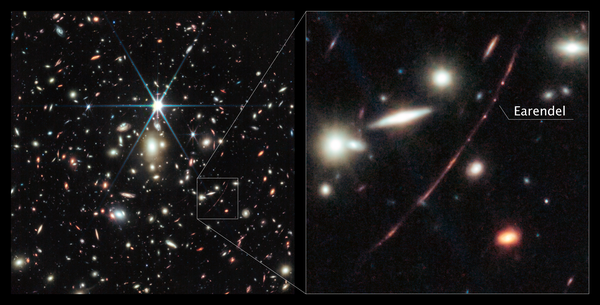
Astronomers have begun measuring of the most distant star ever detected, thanks to the powerful eyes of the James Webb Space Telescope (JWST).
That star, known as Earendel, was discovered last year by the Hubble Space Telescope. It has taken 12.9 billion years for Earendel's light to reach Earth, meaning the star was shining less than a billion years after the Big Bang spurred our universe into existence. However, Earendel doesn't lie a mere 12.9 billion light-years away from us.
Because the universe has been expanding at an accelerating rate since the Big Bang, the star now lives a whopping 28 billion light-years from Earth.
On supporting science journalism
If you're enjoying this article, consider supporting our award-winning journalism by subscribing. By purchasing a subscription you are helping to ensure the future of impactful stories about the discoveries and ideas shaping our world today.
Hubble was able to spot Earendel thanks to a phenomenon known as gravitational lensing, in which the gravity of a massive foreground object sort of acts like a lens as it warps the very fabric of space and time, bending and brightening light from a more distant body as that light passes by.
The JWST team employed this same strategy by harnessing the space-warping power of a gravity cluster called WHL0137-08 that just so happens to line up with Earendel.
The $10 billion scope, which views the universe in infrared light, got a glimpse of Earendel last summer, just after beginning its science operations. But that glimpse has now become something more, as researchers now have enough information to begin characterizing the record-breaking star.
For example, JWST's NIRCam (Near-Infrared Camera) instrument "reveals the star to be a massive B-type star more than twice as hot as our sun, and about a million times more luminous," NASA officials wrote today (Aug. 9) in a statement announcing the new Earendel observations.
Our sun, in case you're wondering, is a G-type star with a surface temperature around 10,000 degrees Fahrenheit (5,500 degrees Celsius). Earendel — which was named after a character in J.R.R. Tolkien's "The Silmarillion," a prequel to "The Hobbit" and the "Lord of the Rings" trilogy — may not be alone in its distant quarter of deep space.
Based on the star's colors, "astronomers think they see hints of a cooler, redder companion star," NASA officials wrote. "This light has been stretched by the expansion of the universe to wavelengths longer than Hubble's instruments can detect, and so was only detectable with Webb."
The existence of a companion would not be a surprise; most big stars like Earendel are part of binary systems, NASA officials noted.
The JWST's observations are also shedding new light on the Sunrise Arc, the galaxy that Earendel calls home.
For example, the scope has identified a star-forming region in the galaxy that's thought to be less than five million years old from our perspective. Its imagery also revealed a more established star cluster near Earendel that appears to be gravitationally stable and has perhaps even persisted into the present day — if its stars are still alive, that is.
And more insights are bound to emerge as JWST continues to study Earendel and other ancient stars.
"The discoveries have opened a new realm of the universe to stellar physics, and new subject matter to scientists studying the early universe, where once galaxies were the smallest detectable cosmic objects," NASA officials wrote. "The research team has cautious hope that this could be a step toward the eventual detection of one of the very first generation of stars, composed only of the raw ingredients of the universe created in the Big Bang — hydrogen and helium."
Copyright 2023 Space.com, a Future company. All rights reserved. This material may not be published, broadcast, rewritten or redistributed.