

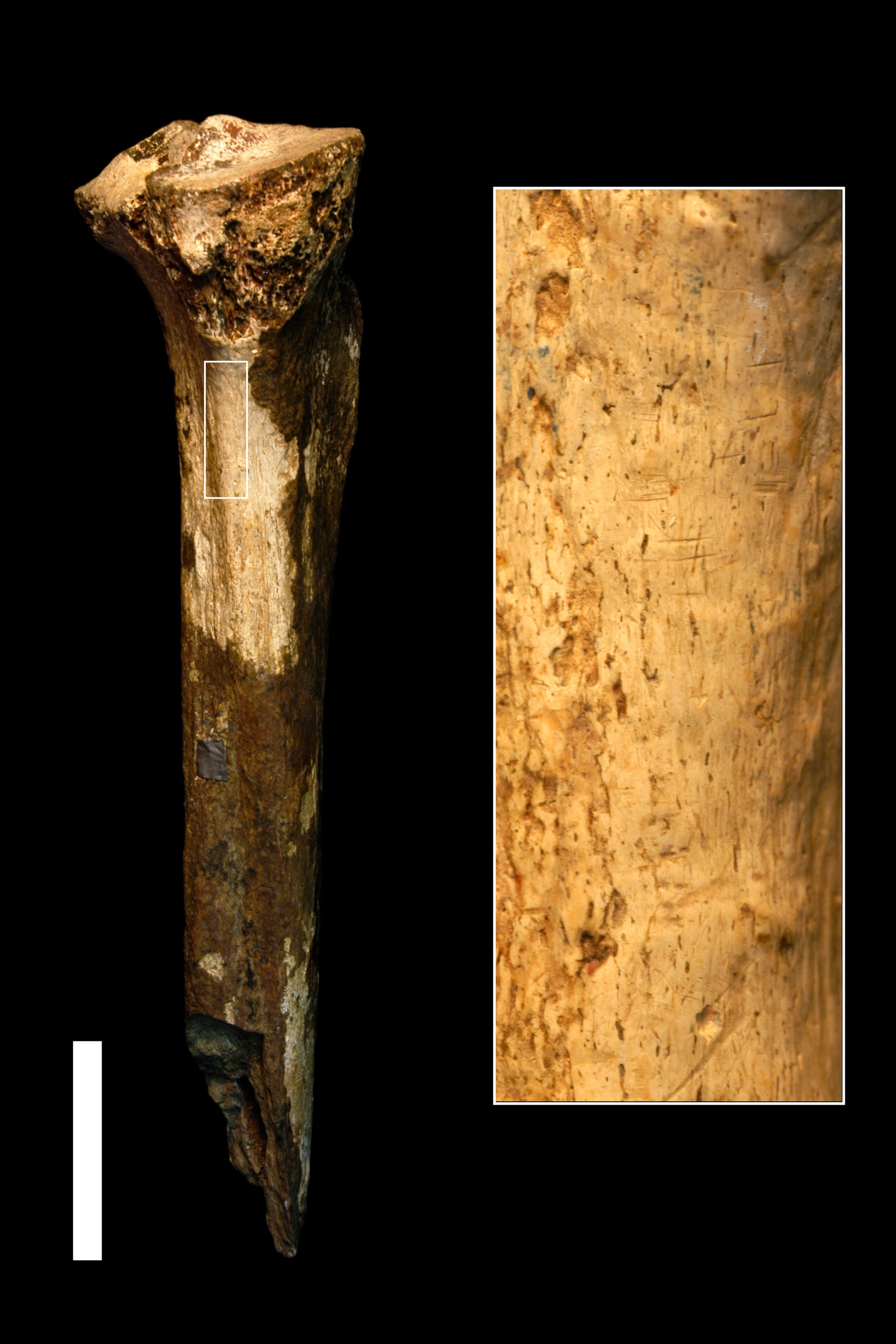
A fossilized leg bone bearing cut marks made by stone tools might be the earliest evidence that ancient humans butchered and ate each other’s flesh.
The 1.45-million-year-old hominin bone, described in Scientific Reports on 26 June, features cuts similar to butchery marks found on fossilized animal bones from around the same time. The scrapes are located at an opportune spot for removing muscle, suggesting that they were made with the intention of carving up the carcass for food.
“The most logical conclusion is, like the other animals, this hominin was butchered to be eaten,” says study co-author Briana Pobiner, a palaeoanthropologist at the Smithsonian Institution in Washington DC. The discovery was “shocking, honestly, and very surprising, but very exciting”, she adds.
On supporting science journalism
If you're enjoying this article, consider supporting our award-winning journalism by subscribing. By purchasing a subscription you are helping to ensure the future of impactful stories about the discoveries and ideas shaping our world today.
Cuts, not bites?
Pobiner had been examining a collection of fossils at the National Museums of Kenya in Nairobi — searching for animal bite marks — when she found unexpected linear markings a few millimetres long on the fossil of a tibia belonging to an unidentified hominin species.
Pobiner concluded that the cuts didn’t look like animal bites, but resembled those known to be made by stone tools.
Credit: Jennifer Clark
She took impressions of the features and compared them against a database of nearly 900 marks made on modern bones using a variety of methods, prepared by her colleagues. The researchers concluded that 2 of the 11 marks were from lion bites, but that the other 9 were made by stone tools — suggesting that one individual might have been butchering another. The authors ruled out other cut-making processes, such as wear or blemishes left by people handling the bone after it was were discovered; the colour of the marks match that of the bone’s surface, indicating they are of the same age, says Pobiner.
Previous evidence of butchery among hominins has been found at sites in Europe and Africa. This includes cuts on a hominin skull found in South Africa that dates to between 1.5 million and 2.6 million years ago, although there is disagreement among researchers about the age of the fossil and the marks’ origin.
Flesh eaters
The context and position of the scratches on the tibia are important in understanding why they might have been made, says Jessica Thompson, a palaeoanthropologist at Yale University in New Haven, Connecticut.
Previous analyses at other archaeological sites found that flesh could have been removed from the bones for ritualistic or funerary reasons in ancient hominin societies. But these behaviours have not yet been observed in hominins found in Kenya around the early Pleistocene period. Furthermore, the marks are located where the leg’s popliteus muscle begins, near the calf. To make this gouge, the cutter must have first removed the larger gastrocnemius muscle — likely a good source of meat.
If the cut marks are the result of early-human butchery, it isn’t possible to say whether they are an example of cannibalism, because the tibia’s species is unknown. Still, the findings offer insights into ancient human behaviour, such as their food-gathering habits.
“This discovery represents more than simply a single odd tale of an unfortunate and long-ago event,” says Thompson. “It suggests that hominins using stone tools to butcher and consume other hominins happened as a typical part of life for our ancestors.”
Zeresenay Alemseged, a palaeoanthropologist at the University of Chicago, Illinois, cautions that these conclusions come from only one fossil. Research that analyses existing and new fossils would illuminate whether early hominins exhibited this sort of behaviour, he says. “The evidence is so sporadic at this point, all we’re doing is connecting the dots,” says Alemseged. “We are trying to go inside the brains of the early hominids, which means it’s going to be very complex.”
This article is reproduced with permission and was first published on June 26, 2023.