
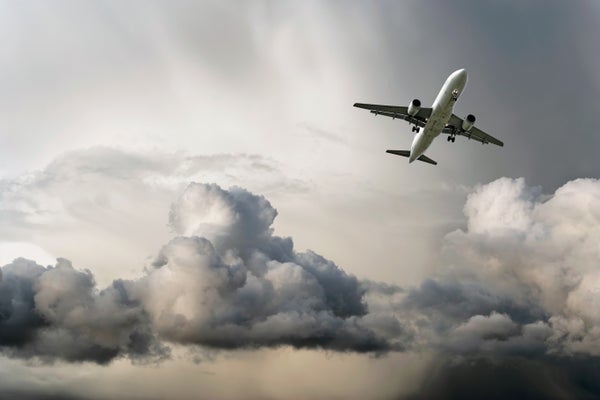
CLIMATEWIRE | Turbulence is more than just an annoyance for frequent fliers. It can cause severe injury to both passengers and crew, and research suggests that climate change will make it worse.
But NASA says it's making progress on a solution that could help pilots anticipate and avoid sudden shifts in air stability.
The technology, under development at NASA's Langley Research Center and involving government, university and private sector experts, anticipates using ground-mounted infrasonic microphones that can pick up ultralow frequencies produced by turbulence — possibly as far as 300 miles away.
On supporting science journalism
If you're enjoying this article, consider supporting our award-winning journalism by subscribing. By purchasing a subscription you are helping to ensure the future of impactful stories about the discoveries and ideas shaping our world today.
If deployed at scale, such microphones could provide an early warning for what’s known as “clear-air turbulence,” the top cause of inflight injuries and fatalities, according to researchers at the University of Reading in the United Kingdom.
Clear-air turbulence differs from other forms of turbulence in several ways, and it can occur without warning at altitudes of 20,000 to 40,000 feet. The unstable air masses can be as much as 100 miles wide and 300 miles long, and they often are found just above the jet stream core, researchers say.
The National Transportation Safety Board reports that 163 people were seriously injured from in-flight turbulence between 2009 and 2022; most of the injuries were to flight crew members. NTSB did not differentiate between clear-air turbulence and weather-induced turbulence.
One recent example occurred in December, when around two dozen passengers were injured on a Hawaiian Airlines flight from Phoenix to Honolulu after the plane experienced severe turbulence about 30 minutes before landing. Twelve of the flight's passengers are now suing, saying that the pilots should have anticipated rough air and instructed passengers to remain buckled in their seats.
Turbulence is expected to get worse too as the world warms.
Scientists at the University of Reading project that the frequency of clear-air turbulence events will double by 2050 and that the intensity of such events will increase by as much as 40 percent.
"Our results confirm that the aviation sector should prepare for a more turbulent future," noted the researchers in their paper, which was published last month in the journal Climate Dynamics.
The NASA research effort could make flight crews, passengers and aircraft more resilient to that future.
"Instead of having to change course when turbulence is encountered, early detection would allow flights to adjust their navigation beforehand, saving fuel and emitting less carbon dioxide into the atmosphere,” a NASA spokesperson wrote in an email.
Infrasound microphones have been a NASA priority since 2007, and the technology underwent early ground testing in 2017 at Langley, where a three-microphone array picked up turbulence 300 miles away, according to NASA. In 2021, researchers tested the technology on two stratospheric glider flights in New Mexico. NASA said the test yielded promising results, and research is ongoing with the agency's private-sector partner, Stratodynamics Inc. of Delaware.
Stratodynamics Vice President Nick Craine said in an interview that data collected from the glider flights is still being analyzed, but he noted it was the "first time in history that an infrasonic signal has been recorded and observed from a fixed-wing, heavier-than-air aircraft."
Sean Bailey, an associate professor of mechanical and aerospace engineering at the University of Kentucky and co-researcher on the project, said more work is needed to determine if the technology can be scaled to a complex, global air-traffic system.
But there's little question that climate change will drive demand for new tools to predict and avoid turbulence.
While specific turbulence incidents cannot be directly attributed to climate change, a recent spate of injury-causing turbulence suggests that pilots are running up against more than bad weather, which they normally can avoid by flying above or around such systems.
Jennifer Stroozas of the National Weather Service’s Aviation Weather Center in Kansas City, Mo., said meteorologists rely on radar, satellite imagery and pilot reports to identify conditions for turbulence.
She added that turbulence can be particularly strong during the winter when the jet stream dips southward over the continental United States, where it can intersect with weather systems and produce strong wind shear.
“We’ve had a really active weather patten over the last couple of months with lots of systems going through," she said. "Our turbulence forecasters have been very busy.”
Reprinted from E&E News with permission from POLITICO, LLC. Copyright 2023. E&E News provides essential news for energy and environment professionals.