
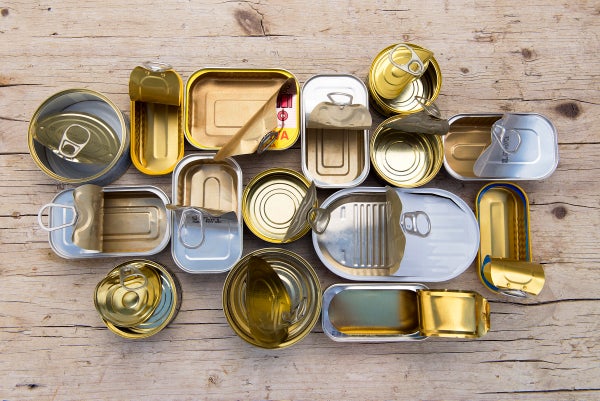
Dear EarthTalk: I’ve often cooked canned foods in their own can, things like condensed milk and mushroom soup. I put the can without opening it in the pressure cooker, cover it with water and let it cook for 30 minutes. The results are amazing. Is it safe to do that? Can metals leach into my food? —Mercedes Kupres, via e-mail
For starters, can makers don’t recommend using their products for anything but storing food unopened until it’s ready to eat. “Cans are reliable, recyclable, durable packages that keep beverages and foods fresh and allow them to be transported safely for thousands of miles, even into remote regions—but they were not made to be used as cooking containers,” says Scott McCarty of Colorado-based Ball Corporation, a leading U.S. food and beverage packaging maker.
Proponents of can-cooking cite the fact that many canned goods are already heated up in their cans to kill bacteria during the canning process, so what harm could a little more heating do? McCarty concedes that some cans are indeed heated during the packing process. “But that isn't all cans or all foods, and it is a carefully controlled and monitored process done in an environment that is made to do it.”
As for what metals may be leaching into your canned food, it depends. In the U.S., most food cans are made of steel while beverage cans are usually made out of aluminum. Chromium and nickel can find their way out of steel, but the amounts would be miniscule to nil. Slightly more troubling is the fact that aluminum—large amounts of which have been linked to nervous system disorders and other health problems—could in theory leach out of cans into their food or drink contents.
In order to prevent any such leaching—which is bad for the food and eater but also for the can (as it can cause corrosion)—the insides of most cans on grocery shelves today are coated with food-grade epoxy. But these liners have been shown to contain Bisphenol-A (BPA) and other potentially harmful chemicals. BPA is a synthetic plastic hardener that has been linked to human reproductive problems and an increased risk of cancer and diabetes. A 2009 analysis of common canned foods by the non-profit Consumers Union found measurable levels of BPA in a wide range of items including some bearing a “BPA Free” label.
The U.S. Food and Drug Administration is currently reviewing whether or not to allow BPA to come into contact with food items at all. In the meantime, some forward-thinking companies aren’t waiting around for an FDA ruling. Eden Foods, which prides itself on the wholesomeness of its products, worked with its packaging manufacturer, Ball Corporation, back in 1999 to switch out traditional epoxy-based liners with a baked-on, BPA-free enamel lining derived from plant oils and resins.
This technology is nothing new; in fact, Eden stumbled upon it by asking Ball what it used before epoxy liners became standard some three decades earlier. While the custom-made cans cost 14 percent more than industry-standard cans would, Eden maintains it’s worth the extra expense (which amounts to some $300,000 extra per year). “It was the right thing to do,” says Michael Potter, Eden’s president. “I didn't want BPA in food I was serving to my kids, my grandkids or my customers.”
CONTACTS: Ball Corporation, www.ball.com; Consumers Union, www.consumersunion.org; U.S. Food and Drug Administration, www.fda.gov; Eden Foods, www.edenfoods.com
On supporting science journalism
If you're enjoying this article, consider supporting our award-winning journalism by subscribing. By purchasing a subscription you are helping to ensure the future of impactful stories about the discoveries and ideas shaping our world today.
EarthTalk is produced by E/The Environmental Magazine. GOT AN ENVIRONMENTAL QUESTION? Send it to: EarthTalk, c/o E/The Environmental Magazine, P.O. Box 5098, Westport, CT 06881; submit it at: www.emagazine.com/earthtalk/thisweek/, or e-mail: earthtalk@emagazine.com. Read past columns at: www.emagazine.com/earthtalk/archives.php