
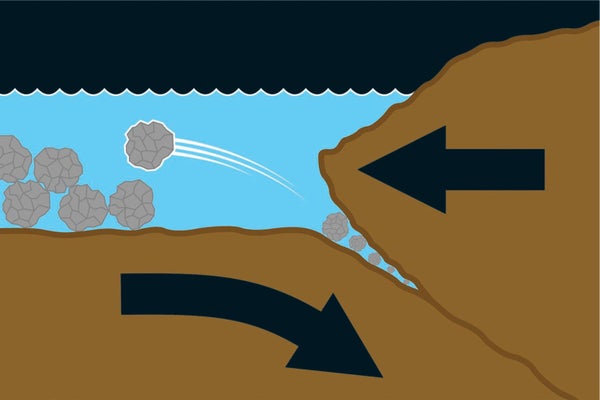
As giant slabs of Earth's crust collide in ultraslow motion, they create mountains, trigger earthquakes and forge new rocks. No one knows how or when this fundamental process, called plate tectonics, began. But an experimental study published in Nature Geoscience suggests early plate tectonics created the oldest rocks on Earth, which are about four billion years old—just short of the planet's age of 4.5 billion years.
“Everyone talks about, ‘When did plate tectonics start?’” says study author Alan Hastie, a University of Edinburgh igneous petrologist. “I think that's the wrong question. It's basically always been.”
But Earth was a warmer, more gooey planet when its magma ocean first solidified, and its brand-new crust would seem more likely to bend than to break into plates. Scientists who use computer models to reconstruct this early environment tend to think plate tectonics began three billion years ago or less, because simulations struggle to show how the process could have started before that. Field geologists, however, often point to four-billion-year-old rocks in places such as Canada and Australia as evidence of an earlier start. These ancient rocks appear to have been made by subduction, when two plates collide to thrust one of them deep into Earth's mantle.
On supporting science journalism
If you're enjoying this article, consider supporting our award-winning journalism by subscribing. By purchasing a subscription you are helping to ensure the future of impactful stories about the discoveries and ideas shaping our world today.
Hastie and his colleagues set out to test whether these oldest rocks could have instead been created at shallower, nonsubduction depths. They took samples from oceanic crust in the southwestern Pacific, which has a composition similar to Earth's first continental crust, and subjected them to high pressures and temperatures to simulate the environment in which they might have formed without subduction, in the upper 50 kilometers of the crust.
The researchers found that this environment couldn't produce samples with the same mineral makeup as the four-billion-year-old rocks. Rocks formed under different pressures and temperatures are composed of different minerals, so this mismatch between the new and ancient samples indicated that the ancient rocks had formed farther—more than 50 kilometers—down. Subduction is the only known process that could push so deep.
“You need to have formed these rocks under much higher pressure—and to get that pressure, the easiest mechanism is subduction,” says Nadja Drabon, a geologist at Harvard University, who was not involved in the new study.
Subduction on early Earth may have been less dramatic than today, with warmer crust less likely to dive as deep into the mantle as modern tectonic plates do, says study co-author Sally Law, a postdoctoral researcher at the University of Edinburgh. This raises new questions about how early Earth's geologic restlessness might have become self-perpetuating, Drabon says. “The big question is, How well would [Earth] be able to sustain a plate tectonic process?” she asks. “That's something we need to do a whole lot more work on.”