
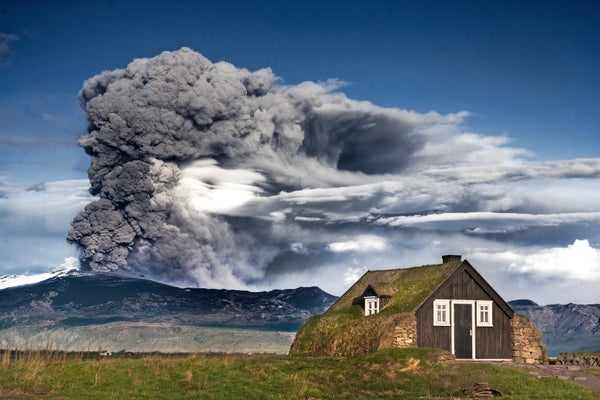
Dear EarthTalk: Could it really be true that a single large volcanic eruption launches more greenhouse gases into the atmosphere than the amount generated by all of humanity over history? --Steve Schlemmer, London, England
This argument that human-caused carbon emissions are merely a drop in the bucket compared to greenhouse gases generated by volcanoes has been making its way around the rumor mill for years. And while it may sound plausible, the science just doesn’t back it up.
According to the U.S. Geological Survey (USGS), the world’s volcanoes, both on land and undersea, generate about 200 million tons of carbon dioxide (CO2) annually, while our automotive and industrial activities cause some 24 billion tons of CO2 emissions every year worldwide. Despite the arguments to the contrary, the facts speak for themselves: Greenhouse gas emissions from volcanoes comprise less than one percent of those generated by today’s human endeavors.
On supporting science journalism
If you're enjoying this article, consider supporting our award-winning journalism by subscribing. By purchasing a subscription you are helping to ensure the future of impactful stories about the discoveries and ideas shaping our world today.
Another indication that human emissions dwarf those of volcanoes is the fact that atmospheric CO2 levels, as measured by sampling stations around the world set up by the federally funded Carbon Dioxide Information Analysis Center, have gone up consistently year after year regardless of whether or not there have been major volcanic eruptions in specific years. “If it were true that individual volcanic eruptions dominated human emissions and were causing the rise in carbon dioxide concentrations, then these carbon dioxide records would be full of spikes—one for each eruption,” says Coby Beck, a journalist writing for online environmental news portal Grist.org. “Instead, such records show a smooth and regular trend.”
Furthermore, some scientists believe that spectacular volcanic eruptions, like that of Mt. St. Helens in 1980 and Mt. Pinatubo in 1991, actually lead to short-term global cooling, not warming, as sulfur dioxide (SO2), ash and other particles in the air and stratosphere reflect some solar energy instead of letting it into Earth’s atmosphere. SO2, which converts to sulfuric acid aerosol when it hits the stratosphere, can linger there for as long as seven years and can exercise a cooling effect long after a volcanic eruption has taken place.
Scientists tracking the effects of the major 1991 eruption of the Philippines’ Mt. Pinatubo found that the overall effect of the blast was to cool the surface of the Earth globally by some 0.5 degrees Celsius a year later, even though rising human greenhouse gas emissions and an El Nino event (a warm water current which periodically flows along the coast of Ecuador and Peru in South America) caused some surface warming during the 1991-1993 study period.
In an interesting twist on the issue, British researchers last year published an article in the peer reviewed scientific journal Nature showing how volcanic activity may be contributing to the melting of ice caps in Antarctica—but not because of any emissions, natural or man-made, per se. Instead, scientists Hugh Corr and David Vaughan of the British Antarctic Survey believe that volcanoes underneath Antarctica may be melting the continent’s ice sheets from below, just as warming air temperatures from human-induced emissions erode them from above.
CONTACTS: U.S. Geological Survey, www.usgs.gov; Carbon Dioxide Information Analysis Center, cdiac.esd.ornl.gov; British Antarctic Survey, www.antarctica.ac.uk.
EarthTalk is produced by E/The Environmental Magazine. GOT AN ENVIRONMENTAL QUESTION? Send it to: EarthTalk, c/o E/The Environmental Magazine, P.O. Box 5098, Westport, CT 06881; submit it at: www.emagazine.com/earthtalk/thisweek/, or e-mail: earthtalk@emagazine.com. Read past columns at: www.emagazine.com/earthtalk/archives.php.