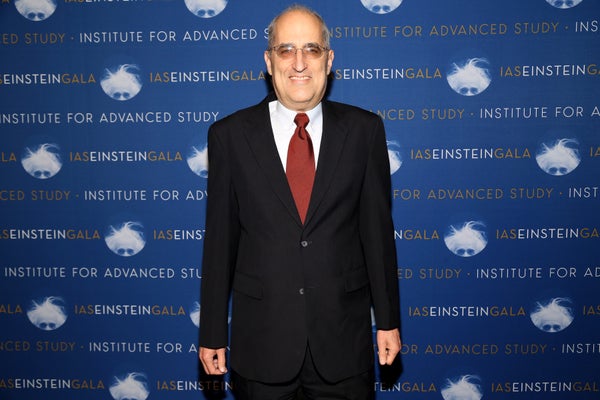
Edward Witten is an American theoretical physicist and professor emeritus at the Institute for Advanced Study. His work in string theory, quantum field theory and mathematical physics has influenced both physics and mathematics. In 1990 he became the first physicist to be awarded the Fields Medal.
[This interview was edited for length and clarity.]
How would you describe the current state of American science?
On supporting science journalism
If you're enjoying this article, consider supporting our award-winning journalism by subscribing. By purchasing a subscription you are helping to ensure the future of impactful stories about the discoveries and ideas shaping our world today.
It's a funny question to ask right now, as you know, because right now there are some clouds concerning funding and graduate student admissions, and so on. I don't have an overview of how severe it is. I do know lots of very strong people in different fields whose federal funding has disappeared, and I find that discouraging.
What needs to change in American science?
It would be nice to go back to the way we were doing things a few years ago. I don’t think that there’s any broad public support for the obstacles the administration is placing for science. This is fairly clear from the fact that Congress rejected the administration’s proposals last year for drastic cuts in the science budgets.
We’re not going to immediately lose our [leadership] because of these cutbacks. It takes time. If there are fewer graduate students, it’s going to have a big impact in 10 years or so. It’s not going to have a big impact next week.
What gives you optimism right now?
Well, one thing that gives me optimism is that I don’t think there’s broad public support for what the administration has been doing. I hope it won’t last.
How has your field changed in the past few years?
I think that the developments involving quantum gravity and quantum information theory have become quite exciting, and to me, that’s the biggest change in the past decade or so. The biggest single advance was when [physicist Geoff] Penington and three others got a better understanding of what’s called the Page curve in the evaporation of a black hole, and that was very clarifying about the nature of black holes at the quantum level. That was the most exciting.