
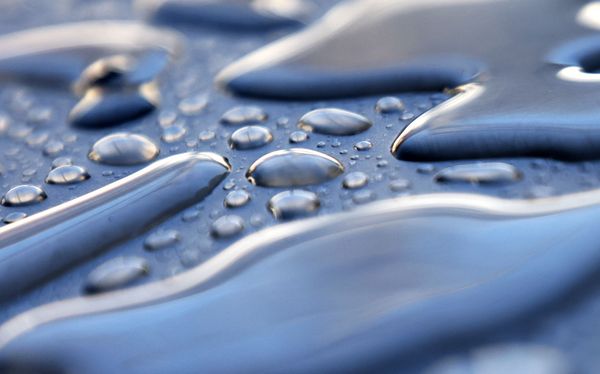
Earth’s weather is suffused with electricity. When particles of ice and hail collide in our atmosphere, they become charged and build up, finally unleashing giant electric sparks in the form of lightning. These are impossible to miss, but even tiny rain droplets can become electrically charged as they fall—and this charge could be enough to eat through metal.
Research, published today in Nature, shows that water droplets become electrified as they move across smooth surfaces. This could help explain why rain corrodes metals even if they have protective coatings. It also helps answer a long-standing question in physics and electrochemistry, says Hans-Jürgen Butt, the study’s lead author and a physicist at the Max Planck Institute for Polymer Research in Mainz, Germany: Why does water take so long to move down smooth surfaces despite the apparent lack of friction?
Butt and his colleagues suspect there is likely some hidden chemistry happening between the surface and the water as it slides down. When solids rub against one another, they can create an electric charge—but physicists didn’t think liquids would behave in a similar way. “For a liquid, there is no force which could break a bond,” Butt says.
On supporting science journalism
If you're enjoying this article, consider supporting our award-winning journalism by subscribing. By purchasing a subscription you are helping to ensure the future of impactful stories about the discoveries and ideas shaping our world today.
In the study, Butt and his team ran water droplets down different surfaces, such as windows and plant leaves, and onto a copper plate with a thin coating of Teflon. The water drops burrowed through the Teflon and into the copper, creating pits. The team looked at metals with other protective coatings as well and saw the same effect. Water that dropped directly onto the plates without running down any other surface did not have the corrosive power.
After studying the shape of the droplets as they approached the coatings and metal plates, the researchers believe the water and copper plate create an electric field, with the water taking on a positive charge as it moves down the surface and the metal taking on a negative charge.
As the drop nears the metal, the electric field gets stronger. Eventually, the field becomes so strong that it breaks down the metal.
Charged rain is not so electric as to have any danger to humans. People have wanted to collect rain to create electricity, but that hasn’t worked on a large scale, Butt says. Still, charged water droplets could help explain why even materials coated with industrial solutions to protect against corrosion sometimes fail if they aren’t applied correctly or become damaged.
Any new information to help understand corrosion is interesting, says Preet Singh, a materials scientist at the Georgia Institute of Technology, who studies corrosion and was not involved in the study. The breakdown of our infrastructure is a trillion-dollar problem—doing a better job of controlling corrosion could save money and lives in the long term, he says.
“I think if you want to have reliable products, whether it’s pharmaceutical or petrochemical or even implants, we need to have very good control on corrosion,” Singh adds.