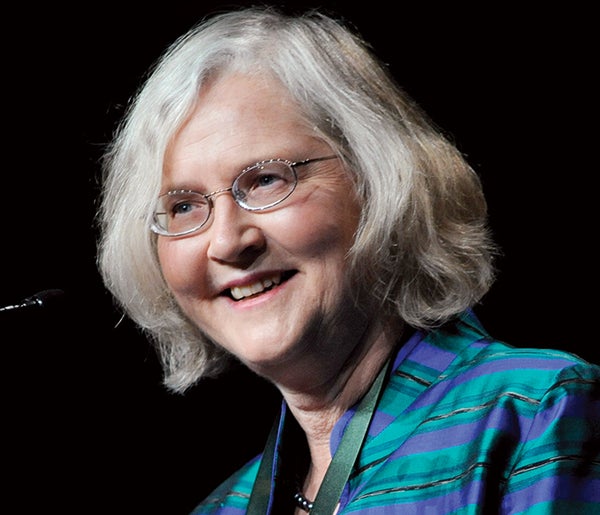
Elizabeth Blackburn is a molecular biologist and biochemist. She is a former president of the Salk Institute for Biological Studies and an emerita faculty member at the University of California, San Francisco. In 2009 she shared the Nobel Prize in Physiology or Medicine for uncovering the structure of telomeres, the protective tips at the ends of our chromosomes that help to safeguard DNA, and for helping to discover telomerase, the enzyme that keeps those tips intact. Blackburn has also received numerous other major awards in science, including the Lasker, Gruber and Gairdner prizes.
An edited transcript of the interview follows.
How would you describe the current state of American science?
On supporting science journalism
If you're enjoying this article, consider supporting our award-winning journalism by subscribing. By purchasing a subscription you are helping to ensure the future of impactful stories about the discoveries and ideas shaping our world today.
I’d say it’s under siege and under assault. The assault is coming from various factors, and one of them has been the systematic attacks on science and its funding and support from the current administration.
There’s also an attack on the access of people who historically have been underrepresented, and that is really hurting efforts to get the most talent into careers in science. It’s just throwing away something that has historically had substantial effects. It just so saddens me and shocks me that we’re throwing away so many opportunities.
The other really sad thing is the assault on truth that we see in public discourse. This is really an assault on science because what is science about? It’s about getting at verifiable truth.
What needs to change in American science?
Science needs to be much more proactive in trying to make sure access is as broad as possible for talented people who might not historically have had access to science, including for socioeconomic reasons. I think doubling down on that is crucial. That means being creative and finding new solutions because we are throwing away real talent and restricting people’s ability to do something they may love to do.
What gives you optimism right now?
I see young people, especially children, who come to places like the California Academy of Sciences museum in San Francisco, and you just see how their curiosity is so great, and they’re sparked. So I have hope. It’s rather distant because these are young people, but I do have hope that this spark of interest and curiosity, which is what drives fundamental science, is alive and well. The spark has not died in children.
What’s your best advice for an early-career scientist?
The short-term challenges are certainly very daunting for younger people, so it’s two things, really. One is to get as much as you can get from mentors, from other scientists. Ask for help. Try to get as much advice as you can, and you’ll be surprised—scientists really want to give one another advice. Other scientists actually want you to succeed.
You think of science as this very competitive thing, and that is true, but we also have a shared culture of wanting one another to succeed because that pushes the field forward. And if you really care about science, then you want it to succeed.
Younger people often are hesitant because they fear that they might be perceived as weak and that they can’t do it themselves. But I would say, no, it’s the opposite. Get help and advice when you can.
And then the other is harder, but it’s keeping the long view. There have been a lot of ups and downs for science, and for many things in our culture, but it won’t necessarily always be like this. Don’t cut yourself off.
How has your field changed in the past few years?
In my case, molecular biologist Carol Greider of the University of California, Santa Cruz, and I discovered telomerase decades ago, and we discovered it through its enzyme activity. Now, after a lot of biochemical work and big advances in imaging and cryoelectron microscopy, you can actually see what telomerase looks like.
On the other end of the spectrum, you can now look at humans using big, computational approaches, big data. It’s enormously beneficial.
There’s been a lot of beautiful work done using very new technologies, so that’s been the big thing: innovations and technologies have driven that aspect of the field enormously.