
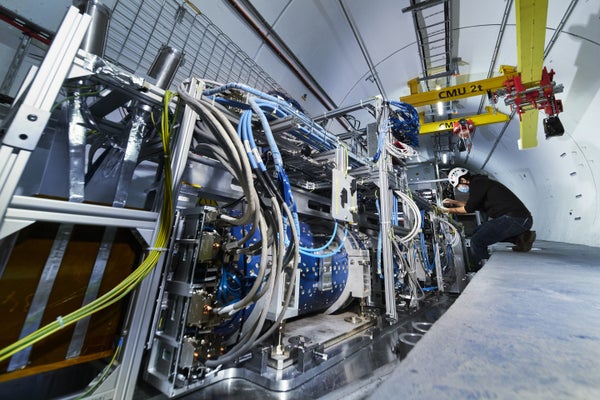
For the first time ever, researchers have detected neutrino candidates produced by the Large Hadron Collider (LHC) at the CERN facility near Geneva, Switzerland.
In a major milestone in particle physics, researchers in a new study report observing six neutrino interactions during an experiment at the LHC. Neutrinos are subatomic particles that have a very small mass like an electron but have no electrical charge—a characteristic that has made them extremely challenging to detect.
These neutrinos were said to have been created during the inaugural run of an emulsion detector that was combined with CERN’s FASER (Forward Search Experiment) collaboration in 2018.
On supporting science journalism
If you're enjoying this article, consider supporting our award-winning journalism by subscribing. By purchasing a subscription you are helping to ensure the future of impactful stories about the discoveries and ideas shaping our world today.
“Prior to this project, no sign of neutrinos has ever been seen at a particle collider,” co-author Jonathan Feng, a physics and astronomy professor at the University of California, Irvine and co-leader of the FASER collaboration, said in a statement. “This significant breakthrough is a step toward developing a deeper understanding of these elusive particles and the role they play in the universe.”
The LHC—which includes four main detectors: ALICE, ATLAS, CMS and LHCb—generally works by colliding two high-energy particle beams with one another close to the speed of light. When the charged particles, like protons, smash into one another at such high speeds, the energy of the impact becomes matter in the form of new particles or subatomic particles. So the LHC can essentially “produce” subatomic particles.
In this run at the LHC, the team was running a pilot test with a new emulsion detector instrument that is made up of dense metal plates of lead and tungsten interspersed with layers of emulsion. Emulsion plates or layers, in physics, work a lot like old-school photography film, Feng explained in the statement. When film strips are exposed to light, photons show themselves as images as the film develops. Similarly, with this instrument, when exposed to the particle collisions, the emulsion layers revealed neutrino interactions after being processed.
Particles colliding during this test produced neutrinos that then smashed into nuclei in the dense metal of the plates. The resulting particles traveled through emulsion layers and created observable “imprints” left behind, according to the statement.
This reported detection of neutrino interactions reveals two major things, Feng shared.
“First, it verified that the position forward of the ATLAS interaction point at the LHC is the right location for detecting collider neutrinos,” Feng said. “Second, our efforts demonstrated the effectiveness of using an emulsion detector to observe these kinds of neutrino interactions.”
This is just the beginning of a highly ambitious quest to detect neutrino interactions and continue to explore the strange world of subatomic particles, co-author David Casper, a FASER project co-leader and associate professor at UCI, said in the same statement.
“Given the power of our new detector and its prime location at CERN, we expect to be able to record more than 10,000 neutrino interactions in the next run of the LHC, beginning in 2022,” Casper said. “We will detect the highest-energy neutrinos that have ever been produced from a human-made source.”
The FASER team has big plans for exploring dark matter at the LHC as well. The team is working towards an experiment with FASER instruments to try and detect so-called “dark photons,” which scientists expect to reveal the behavior and nature of dark matter, according to the statement.
This work was described in a paper published today (Nov. 26) in the journal Physical Review D.
Copyright 2021 Space.com, a Future company. All rights reserved. This material may not be published, broadcast, rewritten or redistributed.