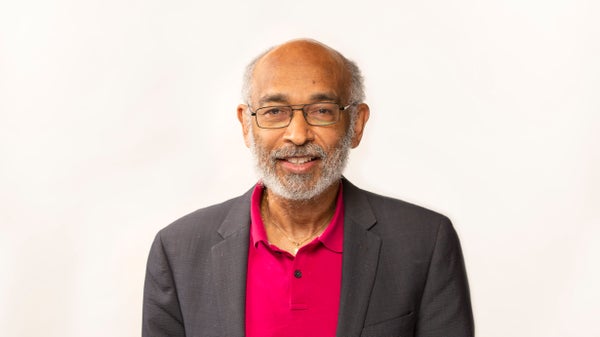
Emery Brown is a physician-scientist, statistician and computational neuroscientist. He is a professor at the Massachusetts Institute of Technology and Harvard Medical School and a practicing anesthesiologist at Massachusetts General Hospital. His research focuses on the neuroscience of anesthesia and methods for analyzing neural activity.
[This interview was edited for length and clarity.]
How would you describe the current state of American science?
On supporting science journalism
If you're enjoying this article, consider supporting our award-winning journalism by subscribing. By purchasing a subscription you are helping to ensure the future of impactful stories about the discoveries and ideas shaping our world today.
The state of American science is strong. To keep it that way, we scientists must be advocates for continued, reliable government support. Government support has historically been the most critical pillar of research in the U.S. We must continue to lobby for that support to maintain it.
What needs to change in American science?
I think that American scientists need to do a better job of sharing our work with public and helping the general public understand what we are doing. We have seen recently how the current moon mission has rekindled an interest in aeronautics, travels to the moon and travels to places beyond. Part of this excitement is because of the intrinsically high interest in space travel. But another part of the excitement is that the many news reports make the material readily accessible to the general public. This type of public education should be applied in other areas of science. Great public support of science is critical for obtaining greater government support.
What gives you optimism right now?
I am optimistic because I see new and exciting findings being discovered every day. To see this, it suffices to follow the weekly seminar series in any M.I.T. department or publications such as MIT Technology Review. Moreover, here at M.I.T., there is a push to bring together science and engineering to address health care problems that need to be solved. With [M.I.T.] president [Sally] Kornbluth’s support, [the university] has developed its Health and Life Sciences (HEALS) program to encourage M.I.T. faculty to look more deeply into solving health care problems. The enthusiasm for HEALS has been contagious across the campus.
What’s your best advice for an early-career scientist?
Don’t throw in the towel. Funding support has become more challenging, but good ideas do find support. Also, now more than ever, there is more research being done outside of academia, in industry. Hence industry is perhaps more than ever a viable alternative to academy. This is certainly the case for research in artificial intelligence.
How has your field changed in the past few years?
Specifically in anesthesiology, there are more investigators that are studying mechanisms of anesthesia questions from a neuroscience perspective. Anesthetics act in the brain and central nervous system. Therefore, neuroscience paradigms should be what are used to understand current approaches for creating the states of general anesthesia and for designing new approaches. There is also a growing interest in using anesthetics to study consciousness. In addition, we now know that not just ketamine but other anesthetics have shown potential to be therapies for treatment-resistant depression.
Is the U.S. still the undisputed destination for the world’s brightest minds, or are we losing that pull?
Other countries, such as China, are expanding their research programs with state-of-the-art resources and generous funding support at all levels. This growth is making it harder for the U.S. to attract some of the best minds from China. In the past, the probability of attracting these scientists to the U.S. was very high. Now it is less so.
What’s a scientific capability we will have in 10 years that we’re currently unprepared to handle?
AI is an area of rapid progress. Many of the potential benefits, as well as the hazards, appear daily. We should proceed to bring it into our workflows wherever possible. But we must do so cautiously, thinking about the consequences—good and bad—of every step.