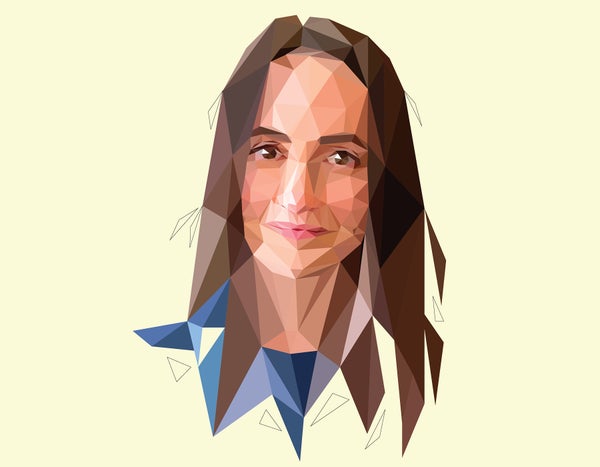
Neuroscientist Emily Finn often trawls Reddit for disagreements about television shows, movies, books or podcasts—any narratives that “evoke really different reactions in different people,” she explains. She is fascinated by the way individuals can walk away from the same story with vastly different takes. “What’s different across the brains of people who ultimately arrive at really different interpretations?” she asks. That question is especially relevant in a time of increasing political polarization, as people’s perspectives on the world sharply diverge.
Finn, who works at Dartmouth College, has focused her career on finding what makes individual brains unique. In 2014 she and her colleagues discovered that scans of people’s brain networks are different enough to function like fingerprints. What’s more, these particular patterns could be used to predict types of intelligence.
On supporting science journalism
If you're enjoying this article, consider supporting our award-winning journalism by subscribing. By purchasing a subscription you are helping to ensure the future of impactful stories about the discoveries and ideas shaping our world today.

Tony Luong
These findings flip the neuroscientist’s typical approach to studying the brain. Usually researchers look for commonalities across groups of similar people rather than differences. They do so because of imprecise scanning technology—you can be more certain about your results if you see the same patterns across many people. But Finn’s findings have shown that there is meaningful information in the differences, too. To find those differences, her team measures brain activity as different people watch the same video clips or listen to the same stories.
Our divergent brains—which can see the same movie, TV show or scientific dataset and interpret it completely differently—are a blessing, Finn thinks. “We don’t want to live in a world where everyone thinks exactly the same way,” she says. Cognitive variation is what allows our species to be so creative and innovative. But this divergence can divide us, too. “It’s definitely a double-edged sword,” Finn says. “But I really think, at the core, [this variation] is a true strength.”
This article is part of “The Young American Scientists,” an editorially independent project that was produced with financial support from Regeneron. Special thanks to the Museum of Science in Boston, where Finn's portrait and video interview were captured.