

“To me it was like knives inside my body—like someone stabbing me from the inside.”* That’s how Noémie Elhadad describes the pain of endometriosis, a condition she has lived with since she was a teenager. Now an associate professor of biomedical informatics at Columbia University, Elhadad is far from alone. Endometriosis—a condition in which the tissue lining the uterus grows outside of it—affects an estimated 10 percent of people with uteruses of reproductive age worldwide. Its symptoms include severe pelvic pain, infertility and pain during sex.
It often takes years for people to get a diagnosis, if ever, and there are few treatments available apart from menstruation suppression, pain management and surgery. Elhadad studies AI and medicine and has developed an app that surveys people with endometriosis about their symptoms. She says that in her experience, “there have been episodes where I nearly felt I was dying.”
Now Swedish company Surgical Science has developed a device designed to better train clinicians to recognize signs of the disease using ultrasound. Making endometriosis diagnosis more accessible could lead to earlier treatment, says Katie Jenner, senior director of the product management team for Surgical Science’s endometriosis simulator, whose new module was announced today.
On supporting science journalism
If you're enjoying this article, consider supporting our award-winning journalism by subscribing. By purchasing a subscription you are helping to ensure the future of impactful stories about the discoveries and ideas shaping our world today.
“We are on a mission to democratize ultrasound education and training,” she says.
Historically, the gold standard for diagnosing endometriosis has been surgery, through small cuts made in the abdomen. But surgery is still invasive and inaccessible to some patients, and many clinicians instead rely on symptoms alone to make a diagnosis. And while some have turned to noninvasive imaging methods such as magnetic resonance imaging (MRI) and transvaginal ultrasound very few doctors receive enough training in how to use ultrasound to diagnose endometriosis. Surgical Science’s endometriosis ultrasound simulator aims to change that.
Part of why it is so hard to diagnose endometriosis using imaging has to do with how the disease manifests. There are three main types of endometriosis. Ovarian endometriomas, also called “chocolate cysts,” are benign blood-filled cysts on the ovaries that are fairly easy to detect on an ultrasound. Deep endometriosis is a more aggressive form in which endometrial tissue invades other organs, such as the bowel and bladder; it’s detectable on an ultrasound, but most gynecologists and surgeons aren’t trained to do that. Superficial endometriosis, meanwhile, is the most common form of the disease and also the hardest to detect. It causes shallow lesions on the membrane that lines the abdominal cavity that are hard to see on ultrasound or MRI.
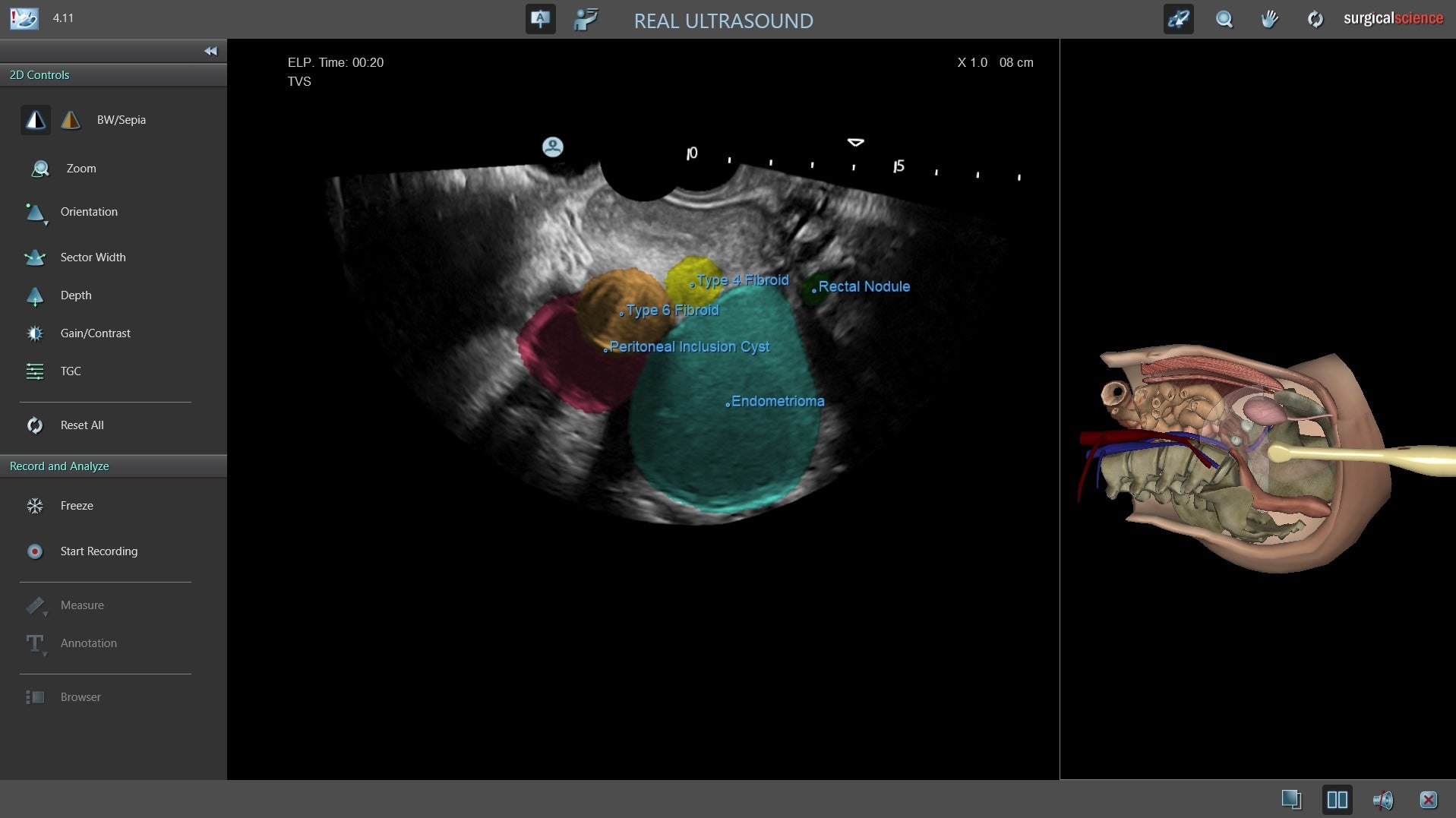
An image from Surgical Science's Ultrasound Mentor product showing Endometrioma and Posterior Uterine Fibroids with labels.
Surgical Science
Surgical Science’s new simulator module incorporates a feature known as the “sliding sign,” which can help better diagnose deep endometriosis. Deep endometriosis causes adhesions, or areas of scar tissue, in organs around the uterus. If pressure from the ultrasound wand causes organs in this area to glide smoothly, that suggests there are no adhesions. But if there is stiff tissue, that can indicate adhesions—and the presence of endometriosis.
According to surveys at workshops in which Surgical Science’s simulator was used, 92 percent of clinicians reported improved understanding of endometriosis diagnosis. And there was a 150 percent increase in confidence in identifying deep endometriosis.
“Better training means faster, more reliable detection,” said Surgical Science CEO Tom Englund in a statement shared with Scientific American.
Currently, the simulator cannot train clinicians to diagnose superficial endometriosis. And ultrasound still lacks the resolution that MRI or surgery can provide. But it’s a step in the right direction, Elhadad says. After all, people with endometriosis often have their pain dismissed or normalized.
“Having access to the diagnosis gives you access to early interventions,” she says. “And I think that’s a very useful thing.”
*Editor's Note (3/12/26): This sentence was edited to correct a typo in Elhadad's quote.