
On supporting science journalism
If you're enjoying this article, consider supporting our award-winning journalism by subscribing. By purchasing a subscription you are helping to ensure the future of impactful stories about the discoveries and ideas shaping our world today.
Nearly four centuries ago Isaac Newton demonstrated that a glass prism could separate white light into all the colors of a rainbow. Now a Switzerland-based team of electrical engineers has built a device that can do something similar for sound—splitting noise into its constituent frequencies by physical means only.
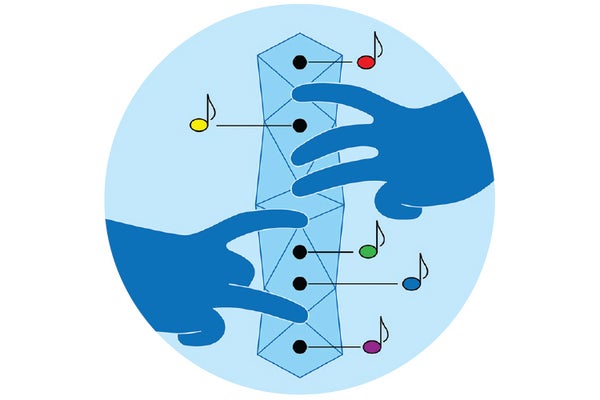
The so-called acoustic prism comprises a 40-centimeter-long hollow aluminum case with a series of 10 holes on its side. Within, flexible polymer membranes divide the case into chambers. These barriers vibrate and transmit sound to neighboring cavities with a delay that depends on a sound wave's frequency. When the delayed waves escape from the holes, they are refracted in different directions so that waves with the lowest frequencies (comparable to red light) can be heard at the end nearest to the source, whereas higher frequencies (comparable to blue light) are refracted farther down the device. “This mimics how a water droplet or glass prism refracts each color of light at different angles,” says Hussein Esfahlani, who studies signal processing at the Swiss Federal Institute of Technology in Lausanne. The device's design was recently published in the Journal of the Acoustical Society of America.
The prism began as a thought experiment according to Esfahlani, but in practical terms it could be used to separate meaningful frequencies from incoming white noise or to determine precisely where a specific frequency is coming from. “This is a very elegant and efficient way for distinguishing sound frequencies,” says Nicholas Fang, a professor of mechanical engineering at the Massachusetts Institute of Technology, who was not involved in the project.