
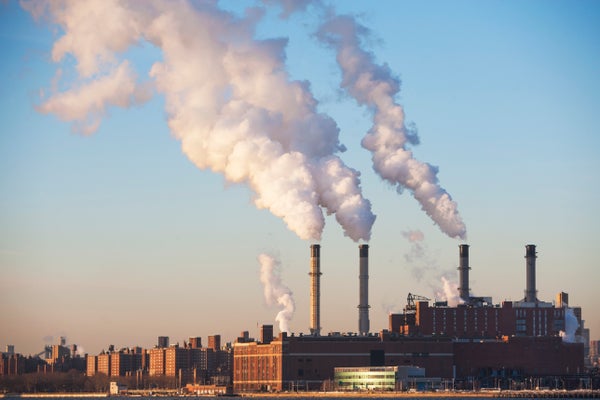
EPA’s move last week to ease pollution enforcement during the novel coronavirus pandemic endangers people who are susceptible to the spreading disease by exacerbating respiratory illnesses, according to public health experts.
Virus hot spots like New York City have historically been exposed to high levels of air pollution from factories, cars and other sources of particulate matter. They also have higher rates of respiratory illnesses compared with other areas of the nation, said Kathy Fallon Lambert of the T.H. Chan School of Public Health at Harvard University.
“EPA’s decision to weaken pollution enforcement could make a bad situation much worse at a time when the demand for medical care is already stressed,” she said. “It’s an unconscionable triple whammy that could lead to increased demands for medical care, increased respiratory illness from air pollution and increased COVID-19 cases.”
On supporting science journalism
If you're enjoying this article, consider supporting our award-winning journalism by subscribing. By purchasing a subscription you are helping to ensure the future of impactful stories about the discoveries and ideas shaping our world today.
EPA announced Thursday that it would use “enforcement discretion” when facilities fail to meet agency requirements for environmental testing, reporting and pollution control because of the pandemic.
A memo by Assistant Administrator Susan Bodine said social distancing guidelines recommended by the Centers for Disease Control and Prevention may limit staff from performing their duties and interfere with companies’ ability to comply with agency rules and consent decrees. Those include meeting “enforceable limitations on air emissions.”
The action, which began retroactively on March 13, would allow EPA to suspend fines and other penalties for noncompliance. It uses the word “temporary” but has no end date.
Environmentalists and public health advocates criticized the move by arguing that laxer pollution requirements for petrochemical plants, power stations and other intensive emitters during a respiratory health crisis could jeopardize public safety.
“Excusing the potential release of excess toxic air pollutants and other pollution that exacerbates asthma, breathing difficulty, and cardiovascular problems in the midst of a pandemic that can cause respiratory failure is irresponsible from a public health [perspective],” states a letter by the Environmental Integrity Project and signed by Cynthia Giles, who held Bodine’s position at EPA under President Obama.
Smog and soot from industrial processes contribute to atmospheric particulate pollution, which causes cardiovascular illnesses.
“Air pollution is strongly associated with people’s risk of getting pneumonia and other respiratory infections and with getting sicker when they do get pneumonia,” said Aaron Bernstein, interim director of the Center for Climate, Health and the Global Environment at Harvard, in an interview circulated by the school.
A study on severe acute respiratory syndrome, or SARS, a 2003 pandemic that is closely related to COVID-19, found that people who breathed dirtier air were about twice as likely to die from the infection, he said.
“Everybody is put at risk from air pollution, but the people who have the greatest impacts are the people who are already at diminished capacity,” said George Thurston, director of the exposure assessment and health effects program at the New York University School of Medicine.
Coronavirus hot spots like New York City, New Orleans, Chicago, Detroit and Los Angeles are bracing for a surge in cases that threaten to overwhelm hospitals.
Incremental increases in pollution could exacerbate the symptoms of other respiratory illnesses, causing more people to seek medical assistance at a time when the U.S. public health system is at a breaking point.
“The last thing you want to do is to be driving more people into the hospital with asthma attacks, heart attacks and the like,” said Thurston.
Air pollution in the United States and other countries has fallen in recent weeks because of slowed economic activity related to the pandemic. But while emissions are lower now, an uptick in pollution could multiply sicknesses, Thurston said.
“There is no known threshold below which air pollution has no effect,” he said.
When the economy ramps up after the worst of the pandemic has passed, the increased pollution promises to have a cumulative impact on public health, especially if EPA extends its nonenforcement policy, he said.
Reporter Corbin Hiar contributed.
Reprinted from Climatewire with permission from E&E News. E&E provides daily coverage of essential energy and environmental news at www.eenews.net.