
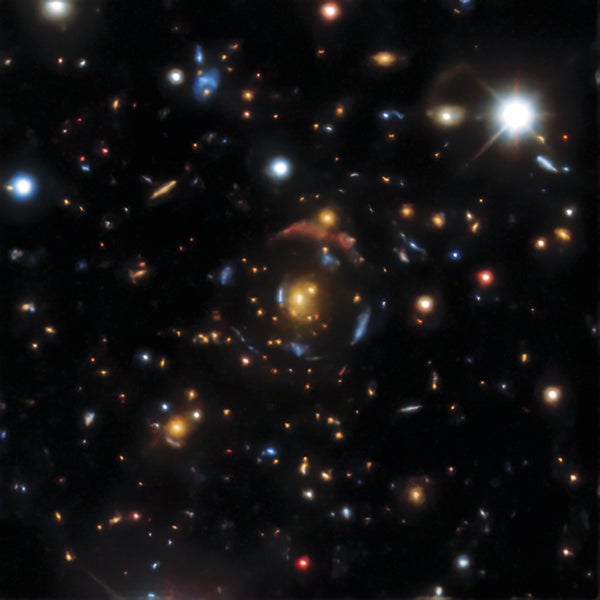
An almost impossible alignment of galaxies that forms a giant magnifying lens could give astronomers an unprecedented deep view of the universe.
The Carousel Lens—named for its concentric circular patterns, like the reflections in a fun-house mirror—incorporates a cluster of galaxies about five billion light-years from Earth whose gravity is so intense that it magnifies the light of seven galaxies behind it, between 7.6 billion and 12 billion light-years away. This phenomenon, called gravitational lensing, occurs only when galaxies line up precisely from our perspective.
As seen from Earth, the massive gravitational lens creates multiple images of six of the seven background galaxies, each of whose light arrives to us by a slightly different path. If a “transient” event, such as a supernova, occurs in any one of those galaxies, astronomers here will have up to four views of it at slightly different times.
On supporting science journalism
If you're enjoying this article, consider supporting our award-winning journalism by subscribing. By purchasing a subscription you are helping to ensure the future of impactful stories about the discoveries and ideas shaping our world today.
“If we had a supernova exploding, we would have as many images of the supernova as we have images of the source,” says cosmologist Nathalie Palanque-Delabrouille, director of Lawrence Berkeley National Laboratory’s physics division, which took part in the lens’s discovery. “That would provide just amazing information.”
Careful observations of both the foreground cluster—which may itself be made up of hundreds of galaxies—and the background galaxies can help astronomers better understand how dark matter and dark energy behave, as well as more about the universe’s ancient past. The farthest background galaxy is so distant that it must have developed in an early phase of the universe, which most scientists think is around 13.7 billion years old.
Researchers used artificial-intelligence systems to find potential gravitational lenses by sorting through millions of galactic survey images. They then arranged for the Hubble Space Telescope to image the location, revealing the Carousel Lens at high resolution.
William Sheu, an astrophysics graduate student at the University of California, Los Angeles, and lead author of a new study about the discovery in the Astrophysical Journal, says analysis of the Hubble images could reveal even more background galaxies that have been magnified by the gravity of the same foreground galaxy cluster.
Gravitational lensing follows Einstein’s 1916 general theory of relativity, which predicted that gravity would bend light; the first such lens was found in 1979. Boston University astronomer Tereasa Brainerd, who was not involved in the discovery, says the lenses have become powerful tools for studying many of the open questions of the cosmos.
“This is an especially remarkable object,” Brainerd says. “It’s the result of outstanding good luck that the lens and the seven background galaxies are almost perfectly lined up along our line of sight.”