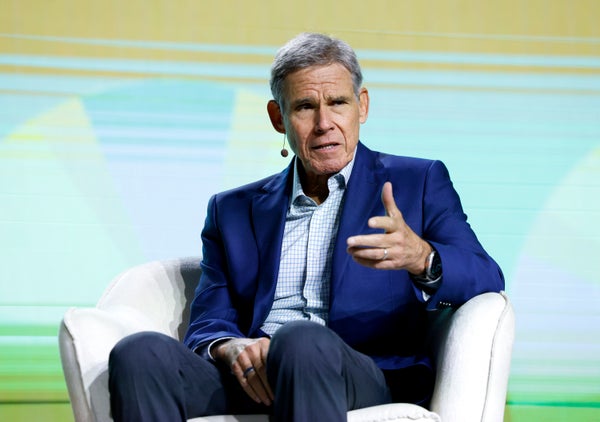
Eric Topol is a cardiologist and scientist who is currently serving as the executive vice president of Scripps Research, the largest nonprofit biomedical research institute in the U.S. He is also founder and director of the Scripps Research Translational Institute. Topol has authored four best-selling books on the future of medicine and publishes Ground Truths, a weekly newsletter and podcast on cutting-edge biomedical advances.
[This interview was edited for length and clarity.]
How would you describe the current state of American science?
On supporting science journalism
If you're enjoying this article, consider supporting our award-winning journalism by subscribing. By purchasing a subscription you are helping to ensure the future of impactful stories about the discoveries and ideas shaping our world today.
Well, there’s no shortage of talent and great minds, but there are definitely bottlenecks. Funding has been a struggle, and the flow of funding even when grants are getting awarded is slow. So it’s not going well.
What needs to change in American science?
What we’re seeing right now is that Chinese science is moving at an exponential pace and is towering above in leading journals. So we have a new strong competitor to be a dominant player in life science, and we need to recognize that there used to be superiority in the U.S., and that’s no longer true.
Years ago, the idea was to triple the National Institutes of Health budget, invest more in science, because it has unlimited potential. Now the opportunities are more vast than ever, and the funding is not proportionate at all to those opportunities. And on the other hand, the investment in China and other countries has never been compromised.
The problem isn’t just that we’re not giving grants out but also that young scientists are getting passed over for support and going into other fields or industry, where you have to do the experiments that the company wants because they’re beholden to their shareholders. So we’re losing out.
What gives you optimism right now?
I do think that we’re going to see huge advances in being able to prevent diseases. I’m not as bullish or sanguine on the new treatments and cures that are being talked about now, but I do think we’re going to have a capability, in the future, to prevent diseases in a way we haven’t before.
What’s your best advice for an early-career scientist?
You definitely want to have some grounding in artificial intelligence. You don’t necessarily have to be an AI guru, but it’d be good for you to get familiar with vibe coding, with multiagent, OpenClaw-type formats, because that just empowers you. Knowing the nuances and understanding the capabilities of AI is going to be increasingly important for successful biomedical scientists. It just opens things up to an extraordinary degree.
How has your field changed in the past few years?
Up until three years ago, we didn’t really have access to AI, so we were limited to kind of a unimodal, mostly self-supervised interaction with medical images. Now we can use AI to analyze data and multilayered, multidimensional data like never before.