New Issue: Orbital Catastrophe Ahead? Read Now

After 8 years in space, the spacecraft BepiColombo is finally nearing Mercury

In a critical maneuver on Thursday, the mission successfully deployed its two science orbiters—beginning the final phases of its arrival at Mercury

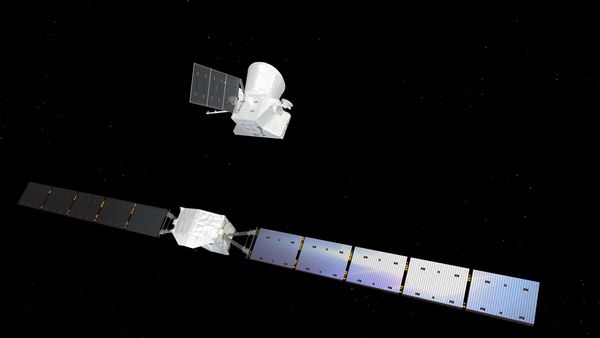
Artist’s impression showing the Mercury Transfer Module separate from the BepiColombo Mercury Planetary Orbiter (MPO) and Mercury Magnetospheric Orbiter (MMO) composite spacecraft.

An artist’s impression shows the BepiColombo composite spacecraft’s Mercury Transfer Module separate from its Mercury Planetary Orbiter (MPO) and Mercury Magnetospheric Orbiter (MMO).

ESA/ATG medialab

Join Our Community of Science Lovers!

Mercury, the closest planet to the sun, is extremely difficult to study up close. In fact, just one spacecraft, NASA’s MESSENGER, has ever orbited the planet. But soon a second mission will begin exploring this rocky world to tease out new details about its surface, interior and interaction with our star. And on Thursday that mission—BepiColombo, a joint operation of the European Space Agency (ESA) and the Japan Aerospace Exploration Agency (JAXA)—took a critical step closer to beginning in earnest.

After an eight-year voyage in space, BepiColombo’s two component science orbiters, which will together observe Mercury, have split off from the spacecraft’s Mercury Transfer Module: the ESA’s Mercury Planetary Orbiter and JAXA’s Mercury Magnetospheric Orbiter were released and gave out a strong signal to Earth, according to an ESA livestream of the procedure.

The job isn’t done yet. Now that they’ve separated from the transfer module, the Mercury Planetary Orbiter and Mercury Magnetospheric Orbiter will remain joined together until November, when they’ll enter orbit around Mercury. A month later, they’ll go on their separate orbital paths before full science operations begin next April.


On supporting science journalism

If you're enjoying this article, consider supporting our award-winning journalism by subscribing. By purchasing a subscription you are helping to ensure the future of impactful stories about the discoveries and ideas shaping our world today.


The ESA orbiter will gather data on Mercury’s topography and interior structure and will put Einstein’s general theory of relativity to the test, while the JAXA orbiter will study the planet’s magnetosphere and magnetic field.

BepiColombo has already had a couple of close interactions with Mercury: it conducted flybys that used the planet’s gravity to help it get toward the proper position to accomplish its mission. During one such flyby in 2021, the spacecraft captured some photographs of the surface from just 199 kilometers (123 miles) away.

An image taken by BepiColombo shows that large regions of Mercury’s heavily cratered surface are smoothed over by lava from volcanic eruptions.

An image taken by BepiColombo shows that large regions of Mercury’s heavily cratered surface are smoothed over by lava from volcanic eruptions.

ESA/BepiColombo/MTM

Subscribe to Support Independent Journalism

Great science journalism requires human expertise, time, effort and creativity. And it costs money. That’s why I and the journalists here at Scientific American hope you’ll join our community.

When you subscribe, you are supporting staff and freelance journalists who are passionate about telling science stories that are true, important and compelling. Our editors and reporters are often experts in their fields, which means they understand the nuances of big discoveries and can untangle the breakthroughs from the hype. With a subscription, you are also supporting rigorous fact-checking to ensure the words we publish are precise and accurate. And you’re supporting original illustrations, graphics and photos that bring you closer to an advanced laboratory, an ice sheet in Antarctica or a space mission in orbit. You’re helping us craft other types of high-quality journalism as well: Our newsletters are carefully written, edited and curated by staffers you have or will come to know and love. Our Science Quickly podcast is based on original reporting, collaboration with editors and scientists and exacting production.

Subscriptions keep this engine running so we can continue to deliver thoughtful, rigorous and independent science journalism to you. In an era of viral misinformation, this work is crucial. If you value what we do, I hope you’ll consider joining us as a subscriber

Thank you,

Jeanna Bryner, Editor in Chief, Scientific American

Subscribe