
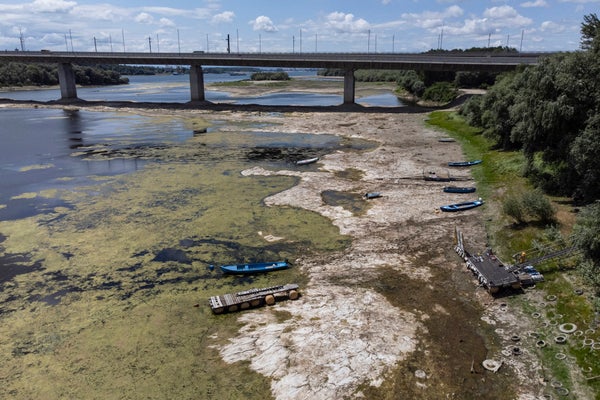
Europe’s climate-change-driven summer of extreme heat has been hitting the continent with a one-two punch: the heat wave has not only killed thousands but has been sucking the water out of rivers, lakes, soils, and plants and fueling destructive wildfires. The strain is testing the adaptations that municipalities have put in place since a hallmark deadly heat wave in 2003.
Repeated bouts of extreme heat led Western Europe to its warmest June on record, according to the European Union’s Copernicus Climate Change Service. The second half of the month had a heat wave that was so intense that it broke monthly and all-time temperature records across several countries. An analysis by the World Weather Attribution (WWA) research group found that these extreme temperatures would’ve been “virtually impossible” without the influence of global warming and that such temperatures were now about 10 times more likely than they would’ve been in 2003. Heat waves themselves are also hotter than they were in the past: conditions like those of Europe’s June heat wave have become up to 2.5 degrees Celsius warmer than they were decades ago, and the event exposed 327 million people and $15.6 trillion in assets to climate-intensified heat, according to an analysis by the research organization ClimaMeter.
That heat has taken a heavy human toll. The European mortality monitoring network backed by the World Health Organization and the European Center for Disease Prevention and Control recorded more than 16,000 excess deaths across 27 European countries during the week of June 22–28 alone, with more than 14,000 of those deaths among people age 65 and older. (Older individuals, young children and those who work outdoors are more vulnerable to heat illness.)
On supporting science journalism
If you're enjoying this article, consider supporting our award-winning journalism by subscribing. By purchasing a subscription you are helping to ensure the future of impactful stories about the discoveries and ideas shaping our world today.
Those tallies are almost certainly undercounts: in 2022 the World Health Organization’s real-time estimate put Europe's heat-related death toll at roughly 15,000, while a later study in Nature Medicine that worked from full mortality records put the true figure above 61,000—more than four times higher than the initial count. The reason for the discrepancy is that heat deaths are typically logged only when a death certificate names heatstroke directly, an approach that misses the much larger toll of heart attacks, strokes and respiratory failures that extreme temperatures trigger in people with existing conditions. Public health researchers have warned that undercounting delays the enactment of better protections because it leads officials and the public to underestimate how lethal heat is until the retrospective data catch up months or years later.
And heat’s damage isn’t limited to the time during a heat wave. A study published in NatureClimate Change found that repeated exposure to extreme heat events accelerates the body's aging process and makes people more vulnerable to health problems—and the magnitude of the effect is comparable to that of regular smoking or alcohol consumption.
Adaptation measures such as government heat action plans, cooling centers and early-warning systems have expanded since Europe’s catastrophic 2003 heat wave, which caused more than 60,000 excess deaths. But researchers behind the more recent mortality studies argue current measures are not enough for a climate that keeps outpacing the adaptations built for it.
The heat is also affecting the livelihoods and food supply of people in Europe and elsewhere because of the simple physics of a warming climate: hotter air holds more moisture, so it pulls harder on whatever water is available, whether that’s a reservoir, a wheat field or topsoil. Another WWA rapid analysis released this week found that record heat has been evaporating water out of rivers, lakes, soils and plants — increased evaporation that led to drought conditions in Western Europe up to 80 times more likely (and in its eastern region up to 40 times more likely) than they would have been without human-induced climate change. By desiccating vegetation, the drought has already fueled severe wildfires, with 116,000 hectares burned in Spain and 42,000 hectares burned in France, according to the WWA report. There have even been wildfires in the normally damp U.K.
The thirstier atmosphere also strains the water supplies that cities, farms and power plants all draw from. France is on track for its lowest maize harvest in 50 years, and Romania has lost more than a million hectares of maize. These losses, layered onto existing global supply strain, could push up food prices. Higher costs would hit low-income households hardest—households that are already hard-hit by the financial strain of drinking-water rationing and non-essential-use restrictions that are underway across Europe, according to the WWA.
Low river levels are disrupting cargo transport, and water scarcity is straining hydropower-dependent regions. The Rhine River at Lobith, the Netherlands—one of Europe’s busiest cargo corridors—saw its flow drop to 715 cubic meters per second on the weekend of July 18–19. This statistic is the lowest recorded for that month, breaking a record set during 1976’s severe drought, according to Rijkswaterstaat, the Dutch water authority.
“What’s most alarming is that these conditions are occurring at 1.4 [degrees] C of warming,” says Mariam Zachariah, a research associate at the Center for Environmental Policy at Imperial College London. “If global emissions push temperatures up to 2.8 [degrees] C as predicted, these intense evaporative conditions could double in likelihood, turning droughts like this one into regular occurrences. Without rapid, aggressive emissions cuts, Europe is heading for a future where these scorching, dry summers happen time and time again.”