
Half of the world’s photosynthesis takes place in single-celled organisms floating on the ocean. Called phytoplankton, this suite of tiny creatures also forms the base of the ocean’s food chain from atop the waves.
In short, the organisms are powerful. But they don’t act alone. Embedded in their exterior are even smaller bacteria, which scientists collectively refer to as “the phycosphere.” The close relationship between the two types of organism involves an exchange of vital chemicals that enables both to survive. For example, in some phytoplankton, the phycosphere bacteria excrete molecules that bind relatively-rare iron. Sunlight then degrades the nutrient, making it available for the phytoplankton to use.
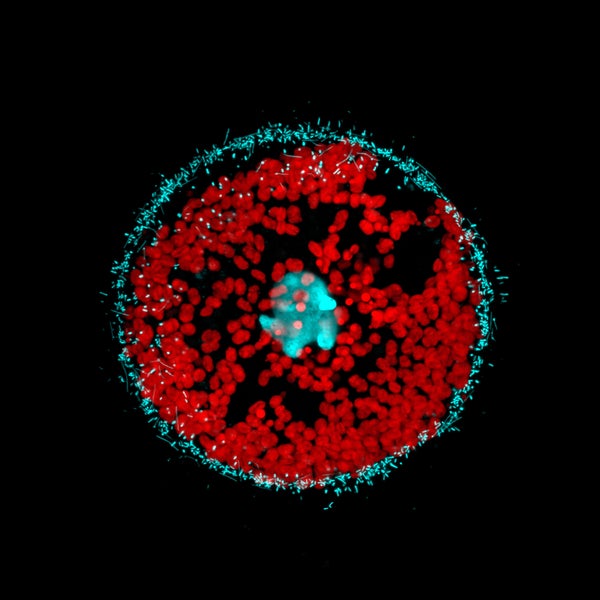
How miniscule are these phytoplankton residents? The algal cell pictured here in red, a Coscinodiscus diatom, is 90 micrometers across, or one tenth the width of a ballpoint pen’s tip. The phytoplankton DNA in the center is dyed blue—as is the DNA of all the microbes living in the phycosphere, which show up as clusters of pinpricks around the outside.
On supporting science journalism
If you're enjoying this article, consider supporting our award-winning journalism by subscribing. By purchasing a subscription you are helping to ensure the future of impactful stories about the discoveries and ideas shaping our world today.
This phytoplankton was isolated and photographed by Davis Laundon and Angela Ward of the Marine Biological Association of the United Kingdom, and researchers will pull plenty more from the ocean as they tease apart how the organisms and their inhabitants cooperate. One area of focus might be the influence the phycosphere has on harmful algae blooms. These increasingly common and toxic surges of some phytoplankton species seem to be aided or counteracted by different bacteria thriving around the algae.