
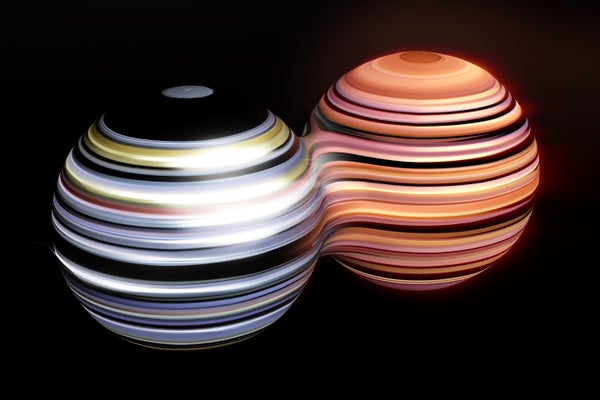
Theoretical physicists have proposed the existence of a new type of particle that doesn’t fit into the conventional classifications of fermions and bosons. Their “paraparticle,” described in Nature in January 2025, is not the first to be suggested, but the detailed mathematical model characterizing it could lead to experiments in which it is created using a quantum computer. The research also suggests that undiscovered elementary paraparticles might exist in nature.
In a separate development published in late 2024 in Science, physicists experimentally demonstrated another kind of particle that is neither a boson nor a fermion—an “anyon”—in a virtual one-dimensional universe for the first time. Anyons had previously been created only in 2D systems.
Because of their unusual behavior, both paraparticles and anyons could one day play a part in making quantum computers less error-prone.
On supporting science journalism
If you're enjoying this article, consider supporting our award-winning journalism by subscribing. By purchasing a subscription you are helping to ensure the future of impactful stories about the discoveries and ideas shaping our world today.
Particle properties
Around the time when physicists began to understand the structure of atoms, a century ago, Austrian-born theorist Wolfgang Pauli suggested that no two electrons can occupy the same state—and that if two electrons are pushed close to being in the same state, a repulsive force arises between them. This so-called Pauli exclusion principle is crucial to the way electrons orbiting an atomic nucleus arrange themselves in shells, instead of all falling to the lowest possible energy state.
Pauli and others soon realized that this empirical rule of exclusion applied not only to electrons but to a broader class of particles, including protons and neutrons, which they called fermions. Conversely, particles that do like to share the same state—which include the photons in a laser beam, for example—became known as bosons. (Pauli and his collaborators also worked out why being a fermion or a boson appeared to relate to a particle’s intrinsic angular momentum, or “spin.”)
If two electrons are pushed close to being in the same state, a repulsive force arises between them.
Mathematically, the fundamental property of fermions is that when two of them switch positions, the wave function that represents their collective quantum state changes sign, meaning that it gets multiplied by –1. For bosons, the wave function remains unaltered. Early quantum theorists knew that, in principle, there could be other kinds of particle whose wave functions changed in more complicated ways when they swapped positions. In the 1970s researchers discovered anyons, which can exist only in universes of one or two dimensions.
Physicists Zhiyuan Wang, now at the Max Planck Institute of Quantum Optics in Garching, Germany, and Kaden Hazzard of Rice University have now constructed a model for paraparticles that can exist in any number of dimensions—and with properties that are different from those of either fermions or bosons. In particular, these paraparticles obey their own type of Pauli exclusion. “It’s not entirely surprising that it’s possible,” says Kasia Rejzner, a mathematical physicist at the University of York in England. “But it’s still cool.”
Wang says he came up with the exotic swapping rules by chance in 2021, while he was doing his Ph.D. “It was the most exciting moment in my life,” he says. Wang adds that it should be possible—although challenging—to realize these paraparticle states on a quantum computer.
1D anyons
Paraparticles share a property with fermions: swapping two particles and then swapping them back restores them to their original state. Anyons generally have a different quantum state even after being restored to their original positions, so they are not classed as paraparticles.
In the Science study, physicists Joyce Kwan and Markus Greiner of Harvard University and their colleagues used light waves to suspend atoms of the isotope rubidium-87 in a vacuum. The atoms tended to stop at the waves’ troughs and only occasionally hop from one to the next, less than one micron away. In these circumstances, rubidium-87 atoms would ordinarily behave like bosons, so that two of them would not mind sharing the same trough. But by periodically tweaking the light’s intensity, the researchers were able to change the atoms’ behavior so that when two atoms swapped places, their wave functions were twisted by a prescribed angle—a defining property of anyons. Probing the wave functions required many repetitions of the experiment, allowing the atoms to wander and then freezing them and imaging the position of each atom, Kwan says.
“I am very excited that the Greiner group has brought anyons in 1D to life,” says Martin Greiter, a theoretical physicist at Julius Maximilian University of Würzburg in Germany.
Because anyons’ wave functions “remember” how two of them were swapped, they could provide a robust way to encode information. This property of memory has already been exploited in virtual 2D anyons built by Google physicists and other teams.
Paraparticles are unlikely to be as robust as anyons, but they could also be useful in quantum computation, Wang says. Intriguingly, they can exist in 3D. In principle, some undiscovered elementary particles could be paraparticles, he adds.
This article is reproduced with permission and was first published on January 8, 2025.