
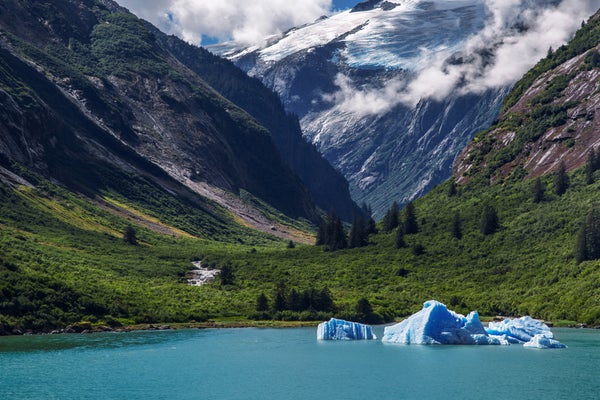
The Trump administration says the Tongass National Forest is America’s best carbon warehouse—so it’s fine to increase logging there.
The Forest Service last week released a draft environmental impact statement for building new roads through the Tongass, a precondition for feeding more old-growth trees into southeastern Alaska’s struggling timber mills. Every 21st-century president has fought over whether to expand or curtail logging in the massive forest. Trump has gone the furthest; his Forest Service last week said the time had come for a final resolution and recommended opening almost the entire area to development.
At stake is the country’s largest forest. The Tongass is among the world’s best carbon sinks, and it’s one of the largest unfragmented ecosystems in North America. Its trees hold about 650 million tons of carbon, which roughly converts to half of U.S. carbon dioxide emissions in 2017.
On supporting science journalism
If you're enjoying this article, consider supporting our award-winning journalism by subscribing. By purchasing a subscription you are helping to ensure the future of impactful stories about the discoveries and ideas shaping our world today.
Trump’s draft EIS says the region plays an “important” role in regulating global climate, and changes in its forests can carry “global consequences.” Those are notable statements from an administration that usually frames emissions deregulation and drilling growth as too insignificant to affect world temperatures.
To justify development in such a critical area, the administration turns to an argument that many scientists reject: Any emissions from logging would be “temporary,” as the timber would sequester carbon in building materials while replacement trees recapture even more CO2. The Tongass’ carbon load has stabilized or possibly even increased since logging peaked in the 1970s and ’80s before declining, according to the draft EIS.
“Potential negative effects on the Tongass may be ameliorated and may be completely reversed with time, reducing or eliminating potential negative cumulative effects on carbon and climate,” the document says.
Beverly Law, an Oregon State University professor whose forestry research is cited in the draft EIS, called the administration’s argument “misinformation.”
Some old-growth trees in the Tongass are more than a thousand years old, so it would take a very long time for the forest to regain such a huge amount of carbon, she said.
“We call it slow in, fast out,” she said in an interview, explaining that emissions from milling and transporting the lumber, along with decomposition of the waste wood, outweigh carbon sequestration.
“We’ve tracked this to landfill, and it’s a significant [amount of] emissions,” she said.
About 500,000 acres of old-growth forest—about 9% of all the trees in the Tongass—has been cut down, but only one-quarter of that has happened since 1990. Some of the region’s lumber mills have shuttered amid the slowdown, prompting the state of Alaska to petition the Trump administration to allow more logging of valuable old-growth trees.
The Trump administration’s preferred course of action would make available another 160,000 acres of old growth, while also nixing prohibitions on roads in 9.2 million acres of the Tongass. The Forest Service said that would happen in accordance with guidelines from the United Nations’ climate authority, the Intergovernmental Panel on Climate Change.
“The management mechanisms applied in all alternatives are consistent with internationally recognized climate change adaptation and mitigation practices identified by the IPCC,” the draft EIS says.
That line baffled Dominick DellaSala, president and chief scientist at the Geos Institute.
“I was one of the reviewers of the IPCC report, and I can tell you: Nothing in that report supports what they’re claiming,” said DellaSala, whose research was also cited in the draft EIS.
The draft EIS warns that Alaska could see an additional 1 to 3.5 degrees Celsius of warming by 2050, but it makes little effort to grapple with the implications of such warming.
“There is considerable uncertainty concerning the exact scope of the effects of climate change on the forests of Southeast Alaska and how best to deal with possible changes to the many resources managed on the Tongass,” the document says.
Climate models show Alaska warming faster than the rest of the country—the changes are already visible—but the Tongass is poised to fare better than its surrounding landscapes, DellaSala said. That could make it an oasis for wildlife that feels climate pressures elsewhere. But destroying habitat by logging and fragmenting the remainder with roads undermines that option, he said.
“Alaska’s going to be in big trouble in the coming century, so why give away the one opportunity to protect those forests that are going to help stabilize the climate?” he said.
Reprinted from Climatewire with permission from E&E News. E&E provides daily coverage of essential energy and environmental news atwww.eenews.net.