
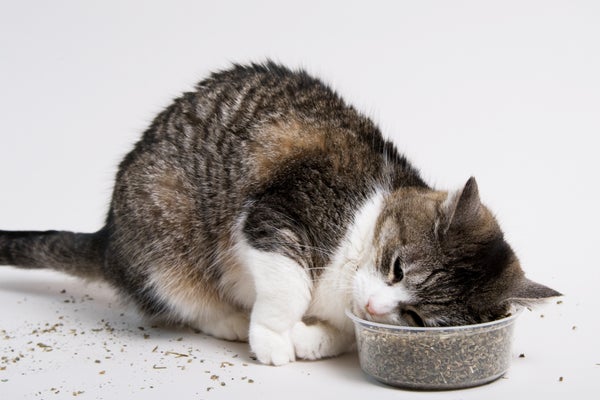
Ramona Turner, a veterinarian specializing in feline care for 25 years, owns two Fresno, California–based animal hospitals. She answers this riddle about our furry friends' strange behavior.
Cats, from our domestic companions to lions and tigers, are exquisitely susceptible to a volatile oil found in the stems and leaves of the catnip plant.
When cats smell catnip they exhibit several behaviors common to queens in season (females in heat): They may rub their heads and body on the herb or jump, roll around, vocalize and salivate. This response lasts for about 10 minutes, after which the cat becomes temporarily immune to catnip's effects for roughly 30 minutes. Response to catnip is hereditary; about 70 to 80 percent of cats exhibit this behavior in the plant's presence. In addition, catnip does not affect kittens until they are about six months old and begin to reach sexual maturity.
On supporting science journalism
If you're enjoying this article, consider supporting our award-winning journalism by subscribing. By purchasing a subscription you are helping to ensure the future of impactful stories about the discoveries and ideas shaping our world today.
Catnip plants (Nepeta cataria and other Nepeta species) are members of the mint family and contain volatile oils, sterols, acids and tannins. Native to Europe, Asia and Africa, the plant was brought to North America by settlers; nowadays, the plant is popular in herb gardens and grows widely as a weed. Catnip is considered to be nonaddictive and completely harmless to cats.
So, how does catnip work? Nepetalactone, one of catnip's volatile oils, enters the cat's nasal tissue, where it is believed to bind to protein receptors that stimulate sensory neurons. These cells, in turn, provoke a response in neurons in the olfactory bulb, which project to several brain regions including the amygdala (two neuronal clusters* in the midbrain that mediate emotional responses to stimuli) and the hypothalamus, the brain's "master gland" that plays a role in regulating everything from hunger to emotions.
The amygdala integrates the information flow from the olfactory bulb cells and projects to areas governing behavior responses. The hypothalamus regulates neuroendocrine responses through the pituitary gland, creating a "sexual response." That is, the cat essentially reacts to an artificial cat pheromone.
Human brains are physiologically different from cat brains and people do not react to catnip by getting "high." Native Americans, however, once used catnip for the uncontrollable cries of infant colic. It also serves as a mild sedative in some herbal teas. In alternative medicine circles, catnip is commonly recommended by herbalists to lessen migraine headaches and to relieve cramps, gas, indigestion, insomnia, nervousness and anorexia, or as an herbal paste to reduce swelling associated with arthritis and soft tissue injury.
*CORRECTION: Initially, this phrase read "two almond-size neuronal clusters in the midbrain..." Almond-size refers to the amygdala in humans, not cats.