
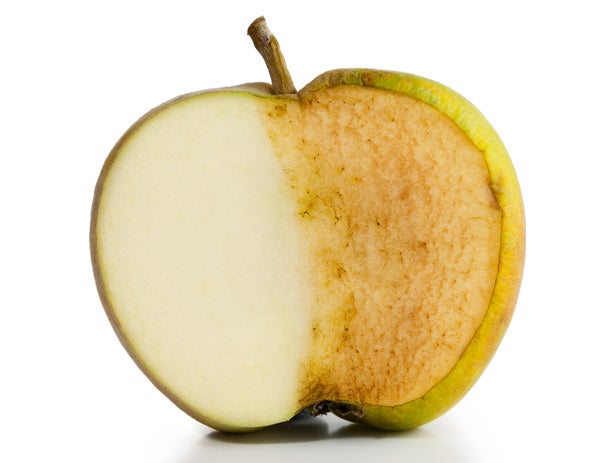
Lynne McLandsborough, a professor of food science at the University of Massachusetts Amherst, explains this oft-observed kitchen conundrum.
When an apple is cut (or bruised), oxygen is introduced into the injured plant tissue. When oxygen is present in cells, polyphenol oxidase (PPO) enzymes in the chloroplasts rapidly oxidize phenolic compounds naturally present in the apple tissues to o-quinones, colorless precursors to brown-colored secondary products. O-quinones then produce the well documented brown color by reacting to form compounds with amino acids or proteins, or they self-assemble to make polymers.
One question that often accompanies yours is, "Why do some apples seem to brown faster than others?"
On supporting science journalism
If you're enjoying this article, consider supporting our award-winning journalism by subscribing. By purchasing a subscription you are helping to ensure the future of impactful stories about the discoveries and ideas shaping our world today.
Well, nearly all plant tissues contain PPO, however, the level of PPO activity and concentration of substrate--here, the phenolic compounds--can vary between varieties of fruits (say, Granny Smith versus Red Delicious). In addition, a tissue's PPO level can vary depending on growing conditions and fruit maturity. One approach the food industry employs to prevent enzymatic browning is to select fruit varieties that are less susceptible to discoloration—either due to lower PPO activity or lower substrate concentration. This approach, however, may not be practical for the home "culinary scientist."
In the home kitchen enzymatic browning can be prevented by either reducing PPO oxidation activity or lowering the amount of substrate to which the enzyme can bind. Coating freshly cut apples in sugar or syrup can reduce oxygen diffusion and thus slow the browning reaction. Lemon or pineapple juices, both of which naturally contain antioxidants, can be used to coat apple slices and slow enzymatic browning. In addition, both fruit juices are acidic and the lower pH that they bring about causes PPO to become less active. Heating can also be used to inactivate PPO enzymes; apples can be blanched in boiling water for four to five minutes to nearly eliminate PPO activity. (Be warned that cooking will affect the texture of the product.)
Enzymatic browning is not unique to apples. PPO—a mixture of monophenol oxidase and catechol oxidase enzymes—is present in nearly all plant tissues and can also be found in bacteria, animals and fungi. In fact, browning by PPO is not always an undesirable reaction; the familiar brown color of tea, coffee and cocoa is developed by PPO enzymatic browning during product processing.