

The following essay is reprinted with permission from The Conversation, an online publication covering the latest research.
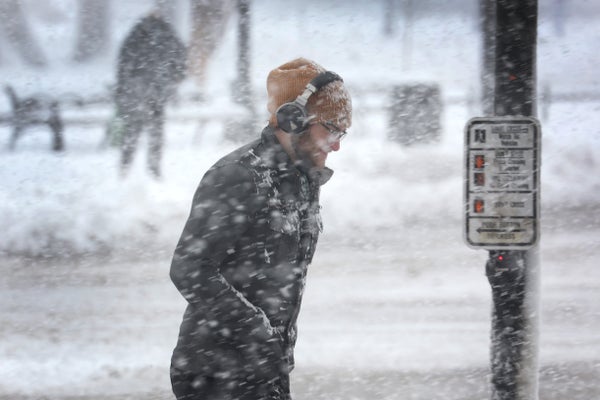
Extremely cold Arctic air and severe winter weather swept southward into much of the U.S. in mid-January 2024, breaking daily low temperature records from Montana to Texas. Tens of millions of people were affected by dangerously cold temperatures, and heavy lake-effect snow and snow squalls have had severe effects across the Great Lakes and Northeast regions.
On supporting science journalism
If you're enjoying this article, consider supporting our award-winning journalism by subscribing. By purchasing a subscription you are helping to ensure the future of impactful stories about the discoveries and ideas shaping our world today.
These severe cold events occur when the polar jet stream – the familiar jet stream of winter that runs along the boundary between Arctic and more temperate air – dips deeply southward, bringing the cold Arctic air to regions that don’t often experience it.
An interesting aspect of these events is that they often occur in association with changes to another river of air even higher above the jet stream: the stratospheric polar vortex, a great stream of air moving around the North Pole in the middle of the stratosphere.
When this stratospheric vortex becomes disrupted or stretched, it can distort the jet stream as well, pushing it southward in some areas and causing cold air outbreaks.
The January 2024 Arctic cold blast fit into this pattern, with the polar vortex stretched so far over the U.S. in the lower stratosphere that it had nearly split in two. There are multiple causes that may have led to this stretching, but it is likely related to high-latitude weather in the prior two weeks.
No, cold doesn’t contradict global warming
After Earth just experienced its hottest year on record, it may seem surprising to set so many cold records. But does this cold snap contradict human-caused global warming? As an atmospheric and climate scientist, I can tell you, absolutely and unequivocally, it does not.
No single weather event can prove or disprove global warming. Many studies have shown that the number of extreme cold events is clearly decreasing with global warming, as predicted and understood from physical reasoning.
Whether global warming may, contrary to expectations, be playing some supporting role in the intensity of these events is an open question. Some research suggests it does.
The February 2021 cold wave that severely disrupted the Texas electric grid was also associated with a stretched stratospheric polar vortex. My colleagues and I have provided evidence suggesting that Arctic changes associated with global warming have increased the likelihood of such vortex disruptions. The effects of the enhanced high latitude warming known as Arctic amplification on regional snow cover and sea ice may enhance the weather patterns that, in turn, result in a stretched polar vortex.
More recently, we have shown that for large areas of the U.S., Europe and Northeast Asia, while the number of these severe cold events is clearly decreasing – as expected with global warming – it does not appear that their intensity is correspondingly decreasing, despite the rapid warming in their Arctic source regions.
So, while the world can expect fewer of these severe cold events in the future, many regions need to remain prepared for exceptional cold when it does occur. A better understanding of the pathways of influence between Arctic surface conditions, the stratospheric polar vortex and mid-latitude winter weather would improve our ability to anticipate these events and their severity.
This article was originally published on The Conversation. Read the original article.