
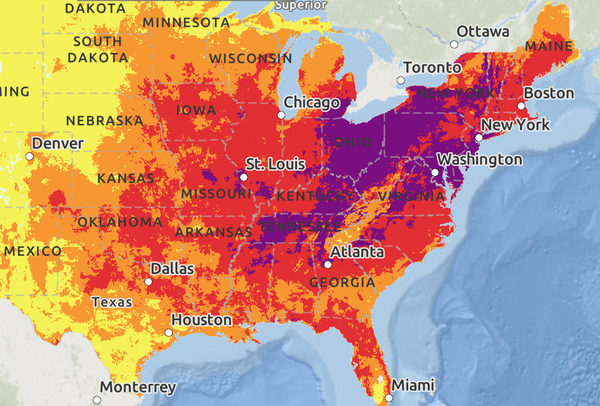
Temperatures across the eastern U.S. could feel as high as 110 degrees Fahrenheit (about 43 degrees Celsius)—potentially even 115 degrees F (46 degrees C)—this week, just in time for the July 4 holiday. That’s because of a heat dome that is blanketing the region, sending the temperature and humidity soaring.
“This is going to be a very prolonged ... heat wave that is going to cover very large parts of the country,” said meteorologist Alan Gerard in a video update on his website, Balanced Weather, on Sunday.
As with any heat wave, the scorching weather comes courtesy of an area of high pressure moving in over the region and then barely budging. Because these atmospheric features bring clear skies, the sun’s rays can beat down relentlessly and build up heat. Temperatures across the eastern U.S. will reach well into the 90s F and above 100 degrees F in some places. High humidity will make those temperatures feel even hotter. The Ohio River Valley, mid-Atlantic and Northeast are likely to see the biggest deviations from seasonal averages.
On supporting science journalism
If you're enjoying this article, consider supporting our award-winning journalism by subscribing. By purchasing a subscription you are helping to ensure the future of impactful stories about the discoveries and ideas shaping our world today.
These temperatures are dangerous, but it’s not just the daytime highs that make a heat wave like this so deadly—overnight lows that stay sultry provide little relief. Many locations will see overnight temperatures drop only into the mid to upper 70s F, says Scott Kleebauer, a meteorologist at the National Weather Service’s Weather Prediction Center. Some places may not even see temperatures dip below 80 degrees F at night.
That could raise the risk of heat illness, such as heat stroke. “There’s a lot of research that shows that overnight low temperatures are one of the big players in how dangerous a heat wave becomes,” meteorologist Gerard said in his video.
As with any heat, climate change is also contributing to this event. The research nonprofit Climate Central shows that, for the hardest-hit areas, warming is making this heat wave four to five times as likely as it would be if global temperatures were not rising.
READ MORE: How to keep your home cool in extreme heat
Certain people are at particular risk of heat exhaustion, heat stroke and other heat-related health problems. These include young children, older people, those who have certain existing health conditions or who are on particular medications, people who work outside and the unhoused.
Forecasters and public health officials are particularly concerned because the heat wave coincides with Independence Day, “one of the busiest times of the year, where a lot of people are going to be doing outside activities,” Kleebauer says. He and other experts warn that people looking to enjoy July 4 safely should stay hydrated, shouldn’t spend a lot of time outside at the hottest points of the day, and should seek shade and air-conditioning as much as possible. Two World Cup matches will be taking place under the heat wave: one in Kansas City, Mo., on July 3 and the other in Philadelphia on July 4.
People should also not leave a pet or child in a car unattended because the interior of a vehicle can heat up rapidly: if the outside temperature is 90 degrees F, the inside of a car will reach 133 degrees F (56 degrees C) in roughly an hour.