
In medieval European cathedrals, the glass sometimes looks odd. Some panes are thicker at the bottom than they are at the top. The seemingly solid glass appears to have melted. This is evidence, say tour guides, Internet rumors and even high school chemistry teachers, that glass is actually a liquid. And, because glass is hard, it must be a supercooled liquid.
Glass, however, is actually neither a liquid—supercooled or otherwise—nor a solid. It is an amorphous solid—a state somewhere between those two states of matter. And yet glass's liquidlike properties are not enough to explain the thicker-bottomed windows, because glass atoms move too slowly for changes to be visible.
Solids are highly organized structures. They include crystals, like sugar and salt, with their millions of atoms lined up in a row, explains Mark Ediger, a chemistry professor at the University of Wisconsin, Madison. "Liquids and glasses don't have that order," he notes. Glasses, though more organized than liquids, do not attain the rigid order of crystals. "Amorphous means it doesn't have that long-range order," Ediger says. With a "solid—if you grab it, it holds its shape," he adds.
On supporting science journalism
If you're enjoying this article, consider supporting our award-winning journalism by subscribing. By purchasing a subscription you are helping to ensure the future of impactful stories about the discoveries and ideas shaping our world today.
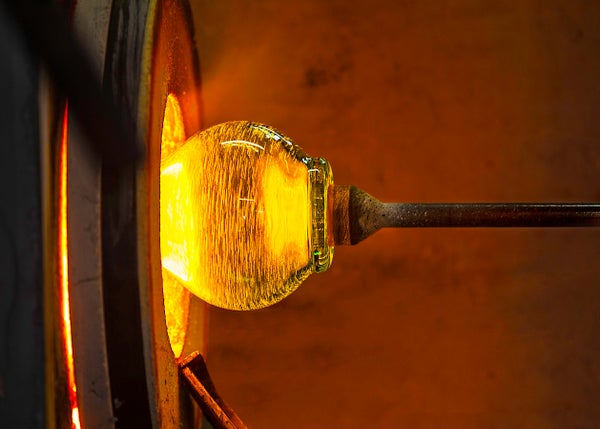
When glass is made, the material (often containing silica) is quickly cooled from its liquid state but does not solidify when its temperature drops below its melting point. At this stage, the material is a supercooled liquid, an intermediate state between liquid and glass. To become an amorphous solid, the material is cooled further, below the glass-transition temperature. Past this point, the molecular movement of the material's atoms has slowed to nearly a stop and the material is now a glass. This new structure is not as organized as a crystal, because it did not freeze, but it is more organized than a liquid. For practical purposes, such as holding a drink, glass is like a solid, Ediger says, although a disorganized one.
Like liquids, these disorganized solids can flow, albeit very slowly. Over long periods of time, the molecules making up the glass shift themselves to settle into a more stable, crystallike formation, explains Ediger. The closer the glass is to its glass-transition temperature, the more it shifts; the further away from that changeover point, the slower its molecules move and the more solid it seems.
Whatever flow glass manages, however, does not explain why some antique windows are thicker at the bottom. Other, even older glasses do not share the same melted look. In fact, ancient Egyptian vessels have none of this sagging, says Robert Brill, an antique glass researcher at the Corning Museum of Glass in Corning, N.Y. Furthermore, cathedral glass should not flow because it is hundreds of degrees below its glass-transition temperature, Ediger adds. A mathematical model shows it would take longer than the universe has existed for room temperature cathedral glass to rearrange itself to appear melted.
Why old European glass is thicker at one end probably depends on how the glass was made. At that time, glassblowers created glass cylinders that were then flattened to make panes of glass. The resulting pieces may never have been uniformly flat and workers installing the windows preferred, for one reason or another, to put the thicker sides of the pane at the bottom. This gives them a melted look, but does not mean glass is a true liquid.