
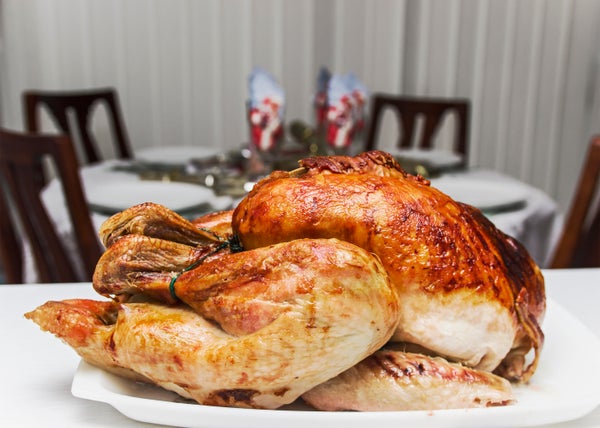
Let us give thanks on Thanksgiving for its cornucopia of foods: mashed potatoes, gravy, stuffing, creamed corn, cranberry sauce and, of course, turkey, among other delights. Every fourth Thursday of November, friends and family in the U.S. travel thousands of miles to gather and gorge in a celebration tracing back to 1621 when Plymouth Pilgrims and Native Americans spent three days breaking bread in gratitude for the year's plentiful harvest.
Those early revelers were probably knocked out by their marathon feast, and most people today are familiar with the post-Thanksgiving food coma. But often the blame falls on the bird. Turkey allegedly causes drowsiness because it is packed with a nutrient called tryptophan.
Tryptophan is one of 20 naturally occurring amino acids—the building blocks of proteins. Because the body is unable to manufacture tryptophan on its own, it must be obtained from food protein. Turkey is a great source of this essential acid, but it is not unique: many meats and other protein products pack comparable amounts.
On supporting science journalism
If you're enjoying this article, consider supporting our award-winning journalism by subscribing. By purchasing a subscription you are helping to ensure the future of impactful stories about the discoveries and ideas shaping our world today.
Tryptophan is used by the human body to make serotonin, a neurotransmitter. It has a somnolent effect on fruit flies, whose sleep is most likely equivalent to our slow-wave (non-REM) sleep, says neuroscientist Amita Sehgal of the University of Pennsylvania School of Medicine in Philadelphia. Other studies show that one function of serotonin is the promotion of slow-wave sleep in nonhuman mammals, she adds, and it may do the same for humans.
Thus, it is no wonder that turkey, which provides the raw material for the synthesis of sleep-related serotonin, is purported to have soporific power.
But eating turkey does not translate to amplified serotonin production in the brain, says neuropharmacologist Richard Wurtman of the Massachusetts Institute of Technology's Department of Brain and Cognitive Sciences in Cambridge, Mass.
Turkey and other protein-rich foods contain many amino acids, and tryptophan is the scarcest among them, Wurtman says. After a turkey dinner, several amino acids circulate through the bloodstream. To get into the brain they must be shuttled across the blood–brain barrier by specialized transport proteins. Like passengers trying to board a crowded bus, amino acids compete for rides on these transporters. Not only does tryptophan have paltry representation among the passengers; it also competes with five other amino acids for the same transporter. Aced out by other amino acids, tryptophan thereby has a tough time hitching a ride to the brain.
Taken in isolation, tryptophan would increase brain serotonin, Wurtman says, but no food source contains tryptophan in the absence of other amino acids.
"Paradoxically, what probably makes people sleepy after Thanksgiving dinner is…dessert," he adds. "Eating carbohydrates increases brain serotonin in spite of the fact that there is no tryptophan in carbohydrates."
Gobbling a slice of sweet pumpkin pie, for instance, causes beta cells in the pancreas to secrete insulin, a hormone that allows the uptake of glucose and most amino acids into the tissues. But insulin has little effect on tryptophan, a large percentage of which travels the bloodstream bound to the protein albumin and therefore is unavailable to the tissues, the notable exception being the brain. By sopping up other amino acids from the blood, however, insulin reduces the tryptophan's competition; the transport system is no longer tied up and more tryptophan can cross the blood–brain barrier. As Wurtman and others have shown, when more tryptophan arrives in the brain, serotonin synthesis steps up and serotonin-mediated transmission is amplified among neurons.
There is another reason turkey has been accused of causing drowsiness: Tryptophan is also a precursor to melatonin, a sleep-associated hormone manufactured in the brain's pineal gland. "Melatonin secretion is increased during sleep," and some studies have suggested that melatonin helps people fall asleep as well as adjust their body clocks to new time zones, says psychiatrist Jerry Siegel of the Center for Sleep Research at the University of California, Los Angeles.
But eating loads of turkey, or any tryptophan-rich food for that matter, does not boost melatonin production, Wurtman says. Situated outside the blood–brain barrier, the pineal gland has ready access to blood tryptophan, which it uses to make serotonin. In contrast to how this neurotransmitter functions in the brain, however, pineal serotonin is just a chemical precursor of melatonin; subsequent biochemical reactions in this gland are necessary to convert it to melatonin.
After a turkey meal, blood levels of tryptophan rise, which may amplify the pineal's production of such serotonin, but not melatonin, whose synthesis rate depends on the amount of enzymes available for the subsequent biochemical reactions to occur, Wurtman says.
If turkey is not the culprit, then what besides dessert causes post-Thanksgiving torpidity? It may simply be a function of scarfing down enormous quantities of food.
"Studies have indicated that stretching of the small intestine induces sleepiness and a protein–fat loading of the stomach induces sleepiness," says biologist H. Craig Heller at Stanford University in Palo Alto, Calif., "and, more blood going to the gastrointestinal tract means less going elsewhere,"—for example, the brain or skeletal muscle.
"Also, there is the general phenomenon of parasympathetic tone—rest and digest—that is conducive to sleep," Heller says. Working in opposition to the sympathetic "fight or flight" stress response, the parasympathetic nervous system restores and conserves energy by reducing heart rate and blood pressure while increasing salivation and gastric action for digestion.
Don't forget the beverages either. Thanksgiving feasts are often washed down with bubbling champagne, beer, wine or other spirits. Despite the latter's name, all have a lulling affect on the mind and body. So don't blame the turkey for your postprandial lethargy, instead give thanks for the abundance of drink and carbohydrate-rich, albeit slumber-inducing fare.