
The upcoming atmospheric re-entry of a Chinese Long March 5B rocket body is a reminder of a much larger problem, experts say.
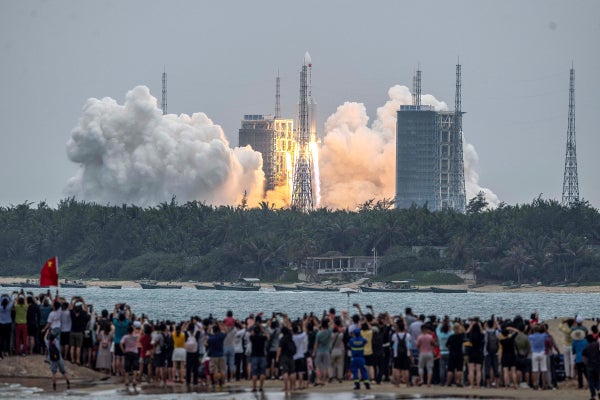
The Long March 5B launched the core module of China’s space station into orbit on April 28. Now satellite and space debris monitoring groups are keeping a close eye on the big rocket’s core stage, which will fall to Earth in an uncontrolled manner soon. Leftover debris from its fiery fall could reach terra firma.
One report has the hardware tumbling along an elliptical orbit and falling to Earth in a few days, perhaps as early as May 9.
On supporting science journalism
If you're enjoying this article, consider supporting our award-winning journalism by subscribing. By purchasing a subscription you are helping to ensure the future of impactful stories about the discoveries and ideas shaping our world today.
But it’s tough to say where the rocket will come down: Nobody knows for sure the exact date and time of the rocket body’s demise. In short, the rocket body equation adds up to a dilemma.
Magnitude of the problem
“It really isn’t about this one rocket body … because every rocket body in Earth orbit is uncontrolled,” explains T.S. Kelso of CelesTrak, an analytical group that keeps an eye on Earth-orbiting objects.
The true magnitude of the problem can be identified by a quick check on CelesTrak.
“It shows there are 2,033 rocket bodies in Earth orbit … at least those that we have orbital data for, as there may be more classified ones. Of course, every one of them is uncontrolled. Of the 2,033, 546 belong to the U.S. and only 169 belong to China.
“Maybe we all need to be more responsible and not leave uncontrolled rocket bodies in orbit,” Kelso told Inside Outer Space.
Where are they?
But the U.S. isn’t even the worst offender in terms of orbiting booster debris. That would be Russia, with 1,035 rocket bodies.
“There are another 66 rocket bodies in Earth orbit that we have no data for, because they are classified,” Kelso noted. That is, there are no “where are they?” orbit elements available. “Most we have no idea what orbit they are in, so they could re-enter or just run into something else in orbit, pretty much without any warning.”
One of those is from a 1967 launch, and eight are from launches in the 1970s, Kelso added.
Bottom line
Just for 2020 launches, there are still 32 rocket bodies in orbit. Fifteen of those pieces of space junk are Chinese. Ten were lofted by the U.S., five of them on classified missions, Kelso said.
“The problem is the number should be zero, and we all need to start working now to make sure we don’t continue to make this problem worse,” Kelso concluded. “But the bottom line is that we all need to do better to stop leaving things in orbit after their intended use, and to find safe ways to remove them.”
Copyright 2021 Space.com, a Future company. All rights reserved. This material may not be published, broadcast, rewritten or redistributed.