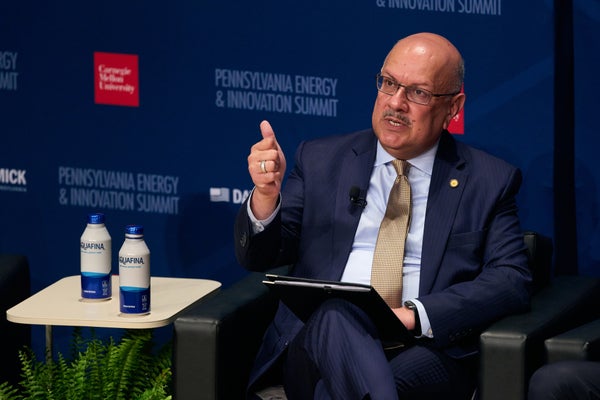
Farnam Jahanian is a computer scientist and president of Carnegie Mellon University. His work has focused on computer systems, cybersecurity and technology policy, and he previously led the National Science Foundation’s Directorate for Computer and Information Science and Engineering.
[This interview was edited for length and clarity.]
How would you describe the current state of American science?
On supporting science journalism
If you're enjoying this article, consider supporting our award-winning journalism by subscribing. By purchasing a subscription you are helping to ensure the future of impactful stories about the discoveries and ideas shaping our world today.
American science remains the global gold standard in many respects, driven by extraordinary talent, world-class institutions and a long tradition of discovery that has shaped modern life. At the same time, the pace of technological change is accelerating, and global competition is intensifying. The expectations placed on science and technology to deliver solutions—quickly and at scale—have never been higher. So I would describe this as both a moment of tremendous opportunity and a moment that demands thoughtful, strategic action to sustain our leadership. For more than 75 years, a strong partnership between universities and the federal government has made this leadership possible—fueling innovation, strengthening our economy and improving the human condition. But today, that foundation is under real pressure. Federal research funding—which has catalyzed breakthroughs from the Internet to lifesaving medical treatments—is facing serious cuts at precisely the moment when our global competitiveness depends on it most.
This compact has always been a shared commitment, with universities investing alongside the federal government in the people and infrastructure that make discovery possible. Weakening that partnership risks slowing scientific progress, limiting opportunity for the next generation of researchers and eroding our national and economic security. To meet this moment, we must renew and modernize this partnership—and just as importantly, rebuild public trust in higher education by clearly demonstrating the value we deliver to society and our commitment to remain accessible, relevant and responsive to the challenges ahead.
What needs to change in American science?
We need to dramatically shorten the distance between discovery and impact. That requires rethinking how we fund, incentivize and translate research—so we can move more seamlessly from basic science to real-world deployment in ways that benefit society. At the same time, we must recognize that the most pressing challenges we face—across health, climate and national security—do not respect disciplinary boundaries. They spill over into the intersections and borders of disciplines and demand deeper collaboration across fields, as well as stronger partnerships among academia, industry and government.
But just as important is how we invest. Time and time again, smart, strategic, early and sustained investment by the federal government has helped to catalyze discovery and innovation that leads to broad societal benefit. While the nation must continue to make large, intentional and sustained bets in critical areas such as artificial intelligence, advanced manufacturing and quantum computing, we cannot lose sight of the full continuum of innovation. From curiosity-driven discovery to scientific infrastructure and talent pipelines that sustain progress—each element across the research continuum is essential and worthy of investment.
And whenever we talk about American science, it is really a discussion about people. Expanding access to education, investing in the next generation of scientists and engineers and ensuring that the benefits of innovation are broadly shared is not just a moral imperative—it is a strategic one. If we get this right, we have an opportunity to position the U.S. as a global model for how to translate discovery into impact—at scale and for the benefit of all.
What gives you optimism right now?
What gives me optimism is the convergence we’re experiencing across AI, data science, engineering and the life sciences. This environment is continuously unlocking new pathways to discovering and solving problems, and the very tools of science itself are transforming in unprecedented ways. As a result, we are moving faster and thinking more expansively than ever before. The next generation of scientists is also a reason for optimism. These individuals are deeply collaborative, mission-driven and eager to innovate at the intersections of disciplines. This combination of technological capability and human ingenuity is incredibly powerful.
What’s your best advice for an early-career scientist?
Regardless of their area of expertise, I would encourage early-career scientists to be intellectually fearless and deliberately interdisciplinary. Science today is a team endeavor, and the most exciting breakthroughs are happening at the edges of fields. Technical excellence is paramount, but so is the ability to take risks, learn from your mistakes and work at the edge and intersections of disciplines to transform ideas into knowledge and action.
How has your field changed in the past few years?
I say this often: AI’s rise as a foundational tool for discovery and innovation is one of the most significant intellectual developments of our time. Once a specialized capability, AI is now being seamlessly integrated into systems and embedded in nearly every domain. This change has fundamentally revolutionized the pace of innovation—shifting us away from incremental advances and toward more rapid, system-level transformations across science and engineering. AI and emerging technologies have the potential to compress the discovery cycle at an unprecedented rate, enabling us to move from idea to real-world impact faster than we ever thought possible.