
By Fathin Ungku and Aradhana Aravindan
Many of Singapore's five million people are covering up and staying indoors to avoid mosquito bites as health experts warned that the outbreak of the Zika virus in the tropical city-state would be difficult to contain.
One of the world's leading financial hubs, Singapore is the only Asian country with active transmission of the mosquito-borne virus, which generally causes mild symptoms but can lead to serious birth defects in pregnant women.
On supporting science journalism
If you're enjoying this article, consider supporting our award-winning journalism by subscribing. By purchasing a subscription you are helping to ensure the future of impactful stories about the discoveries and ideas shaping our world today.
Authorities say they have found over 150 cases since the first locally contracted infection was reported a week ago, and with the virus spreading beyond the cluster where it was initially detected, more people are taking precautions.
"I'm not going to let her go outside much until Zika dies down," said Nat Bumatay, a self-employed mother, of her six-year-old daughter Sunshine. "Usually during short holidays, we go outside to the parks, go cycling, but now I will refrain."
A warm, tropical climate, forested areas and a network of public parks make outdoor activities popular across Singapore, especially during school holidays like the ten-day break that began on Friday.
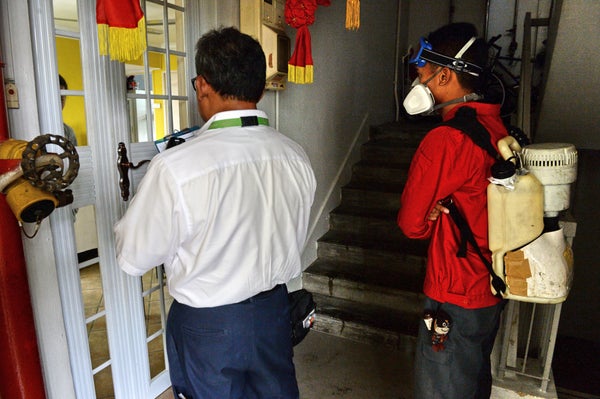
Authorities have stepped up spraying insecticide and clearing stagnant water to prevent mosquito breeding, but many people said they were also avoiding the city's popular outdoor food centers and dousing themselves in repellent to avoid getting bitten.
"Prevention is better than cure," said Tomas Quong, a Filipino who has been working in Singapore for five years. "That's why I am wearing long sleeves."
Some fans of Nintendo's Pokemon Go mobile game are also becoming more cautious and crowds at outdoor Pokemon hotspots around the city are likely to be thinner. "I am still okay with outdoors, just not damp and dirty parks," said Nelson Ho, a 19-year-old gamer.
Pharmacies and supermarkets have reported a surge in mosquito repellent's over the past week, with some running out of stock. Online retailers Lazada and Qoo10.sg have set up a Zika shop, while other enterprising Singaporeans trying to cash in are advertising mosquito net tents and "anti-bite" jewelry.
SLOWING ECONOMY
The outbreak coincides with a slowdown in trade-dependent Singapore. Worries about Zika could further crimp overall retail sales, United Overseas Bank economist Francis Tan said. "If it continues, people will generally not want to go out, so all the retail sectors will be slowing down," Tan said.
Zika could also increase concerns about tourism, a mainstay of the economy, especially with the city-state's key annual attraction - the floodlit Formula One Grand Prix race - due to start in two weeks. Several countries, including the United States and Australia, have advised pregnant women or those trying to conceive not to visit.
"It will certainly create a bit of caution in the minds of tourists and they may think about it twice," said Jonathan Galaviz, partner at consultants Global Market Advisors. "But I don't see Zika standing in the way of a successful F1 event or tourism flows in the short term."
Tourism arrivals topped 8 million in the first half of this year, around 1 million more than a year ago.
The Tourism Board has said it is premature to consider any impact on the industry, with at least two international chain hotels contacted by Reuters reporting business as usual. The promoters of the Grand Prix have also said planning for the event is going ahead "as per normal".
Several of those initially infected by the virus were foreigners, many believed to be among the thousands of migrant workers in Singapore's construction industry.
The latest tally includes two pregnant women, and officials and experts say the number of cases is likely to increase as the virus is likely to spread.
"The virus is extending beyond the square that was drawn out," said Leong Hoe Nam, an infectious disease specialist at Mount Elizabeth Novena hospital in Singapore. "We have re-draw the battle lines. We have to first admit defeat to Zika and accept that the whole country is at risk."
