
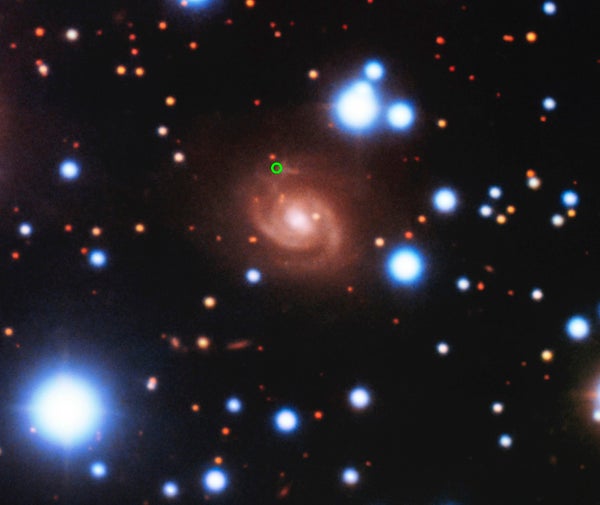
HONOLULU—Mysterious ultra-fast pinpricks of radio energy keep lighting up the night sky and nobody knows why. A newly discovered example of this transient phenomenon has been traced to its place of origin—a nearby spiral galaxy—but it’s only made things murkier for astronomers.
The problem concerns a class of blink-and-you’ll-miss-them heavenly events known as fast radio bursts (FRBs). In a few thousandths of a second, these explosions produce as much energy as the sun does in nearly a century. Researchers have only known about FRBs since 2007, and they still don’t have a compelling explanation regarding their sources.
“The big question is what can produce an FRB,” Kenzie Nimmo, a doctoral student at the University of Amsterdam in the Netherlands, said during a news briefing on Monday (Jan. 6) here at the 235th meeting of the American Astronomical Society in Honolulu, Hawaii.
On supporting science journalism
If you're enjoying this article, consider supporting our award-winning journalism by subscribing. By purchasing a subscription you are helping to ensure the future of impactful stories about the discoveries and ideas shaping our world today.
Scientists were given some help in 2016, when they discovered an FRB that repeated its quick-pulsing radio tune in random bursts. All previous examples had been one-off events.
The repeating FBR was eventually traced back to a dwarf galaxy with a high rate of star formation 3 billion light-years away, Nimmo said. The galaxy contains a persistent radio source, possibly a nebula, that could explain the FRB’s origin, she added.
Astronomers have also managed to determine that three non-repeating FRBs came from distant massive galaxies with little star formation going on. This seemed to provide evidence that repeating and non-repeating FRBs arose from different types of environments, Nimmo said. But the new discovery challenges this simple story.
FRB 180916.J0158+65, as the object is known, is a repeating FRB discovered by the Canadian Hydrogen Intensity Mapping Experiment (CHIME) observatory, a radio telescope near Okanagan Falls in British Columbia that Nimmo called “the world’s best FRB-finding machine.”
Follow-up observations by a network of telescopes in Europe allowed the research team to produce a high-resolution image of the FRB’s location. This location turned out to be a medium-sized spiral galaxy like our Milky Way that is surprisingly nearby, only 500 million light-years away, making it the closest-known FRB to date. The results were published yesterday (Jan. 6) in the journal Nature.
Despite precisely locating the FRB, the team was unable to detect any radio sources in the spiral galaxy that could explain the mysterious outbursts. Even worse, this new entity seems not to fit the patterns established by previous repeating and non-repeating FRBs.
“This is completely different than the host and local environments of other localized FRBs,” Benito Marcote, a radio astronomer at the Joint Institute for VLBI European Research Infrastructure Consortium and lead author of the Nature paper, said during the news briefing.
The researchers hope that subsequent data might help them get a handle on what this FRB is telling them. But until then, they might have to continue scratching their heads over these puzzling phenomena.
Copyright 2020 LIVESCIENCE.com, a Future company. All rights reserved. This material may not be published, broadcast, rewritten or redistributed.