
On supporting science journalism
If you're enjoying this article, consider supporting our award-winning journalism by subscribing. By purchasing a subscription you are helping to ensure the future of impactful stories about the discoveries and ideas shaping our world today.
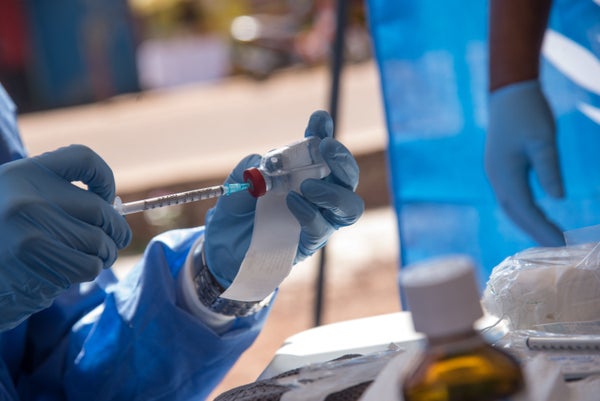
The Food and Drug Administration announced Thursday it has approved an Ebola vaccine developed by Merck, making it the first for the deadly disease approved in the United States.
The vaccine, Ervebo, protects against Zaire ebolaviruses, the species of the virus that has been the most common cause of Ebola outbreaks. Ebola Zaire is the virus responsible for the current long-running outbreak in the Democratic Republic of the Congo.
The FDA’s decision follows similar action taken earlier by the European Commission, which licensed the vaccine on Nov. 11.
“Ebola virus disease is a rare but severe and often deadly disease that knows no borders,” Dr. Peter Marks, director of the FDA’s Center for Biologics Evaluation and Research, said in a statement. “Vaccination is essential to help prevent outbreaks and to stop the Ebola virus from spreading when outbreaks do occur.”
The road to approval has been long for this vaccine, which will likely be stockpiled by some countries — the United States among them — as a hedge against a possible bioterrorism attack.
The vaccine is also likely to make up a substantial portion of an emergency stockpile for outbreaks being put together by Gavi, the Vaccine Alliance, for use in outbreaks. Gavi recently announced plans to establish a 500,000-dose stockpile. The Merck vaccine, given in a single dose, generates a quick immune response, with protection occurring within about 10 days. Those two features make it attractive as a tool for battling an outbreak.
Work on the vaccine stretches back to the 1990s, when a Yale University researcher, John “Jack” Rose, turned a virus that infects livestock — vesicular stomatitis virus — into a vector that could be used for vaccines. In the 2000s, scientists at Canada’s National Microbiology Laboratory led by Dr. Heinz Feldmann modified the vector to make it a delivery system to show the immune system a critical Ebola protein — creating a safe way to teach the immune system to defend against Ebola virus infection.
Though the vaccine appeared highly promising in animal testing, it languished for years; the lack of a traditional commercial market for Ebola vaccines meant pharmaceutical companies showed little interest in partnering on its development. That changed with the catastrophic Ebola outbreak in West Africa in 2014, which reignited interest in the vaccine.
Clinical trials performed in North America, Africa, and Europe culminated in a Phase 3 trial conducted in Guinea, one of the countries ravaged by the West African outbreak. There the vaccine was proven to be effective.
Ervebo has been a key part of the effort to control the current outbreak, the second largest on record, with more than 258,000 people having been vaccinated to date. More than 3,350 have contracted the disease in the outbreak and at least 2,220 have died.
“Approval of this vaccine by the FDA represents another important milestone in the global response to Ebola Virus Disease and stands as a tremendous accomplishment by a unique global partnership,” Dr. Roger M. Perlmutter, president of Merck Research Laboratories, said in a statement Friday.
“In acknowledging this event, I wish in particular to recognize the heroic efforts being made by frontline responders to the ongoing outbreak in the Democratic Republic of the Congo. We are proud and honored to play a role in supporting their vital activities, and we remain focused on the important work ahead,” he said.
By bringing to market a vaccine to protect against Ebola, Merck qualifies for a tropical disease priority review voucher, an incentive meant to spur development of treatments for diseases that would otherwise be neglected because of a lack of financial incentive for the pharmaceutical industry.
Merck can use the priority review voucher to secure a fast-tracked FDA review of a future drug or vaccine it wants to bring to the U.S. market. Priority review vouchers can also be sold. Prices for the vouchers have varied as more of them have been issued in the past few years, falling from a high of $350 million in 2015 to around $100 million more recently. In December, Bavarian Nordic sold a priority review voucher it had earned to an undisclosed purchaser for $95 million.
Ervebo has been used in the current outbreak in DRC under “compassionate use,” a research protocol similar to one used in a clinical trial. It will continue to function in this manner for the foreseeable future because the vaccine currently being used was manufactured while the vaccine was unlicensed. The company is moving to start producing licensed doses of the vaccine, but that is a process that takes the better part of a year.
>Merck announced it has submitted Ervebo for approval to the regulatory authorities in a number of African countries at risk of having Ebola outbreaks. The vaccine has been prequalified by the World Health Organization, a process that could speed approval in African countries.
Republished with permission from STAT. This article originally appeared on December 19, 2019