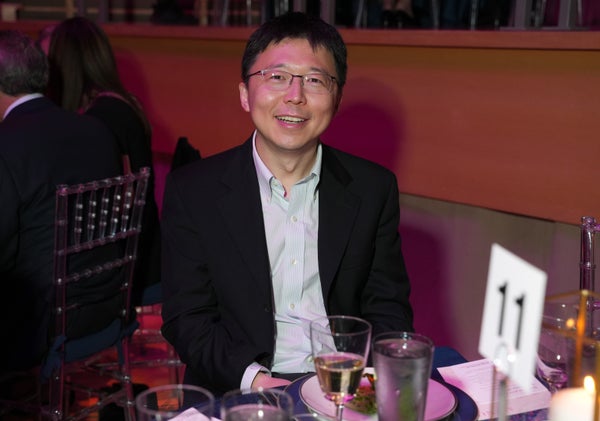
Feng Zhang is a molecular biologist at the Massachusetts Institute of Technology and the Broad Institute of M.I.T. and Harvard University whose research focuses on genome engineering and neurobiology. He helped develop CRISPR-based genome-editing tools for use in human cells and studies biological systems for therapeutic applications.
[This interview was edited for length and clarity.]
How would you describe the current state of American science?
On supporting science journalism
If you're enjoying this article, consider supporting our award-winning journalism by subscribing. By purchasing a subscription you are helping to ensure the future of impactful stories about the discoveries and ideas shaping our world today.
American science has long been the strongest engine of discovery and innovation in the world. And at the same time, it has rarely been more fragile than it is right now. I’m fortunate to work with extraordinary students and postdocs, but the infrastructure that lets them do their best work is under real stress: funding instability at the National Institutes of Health and the National Science Foundation, immigration uncertainty for international scientists and an erosion of public trust in expertise. We can lose the lead rapidly if we do not protect our innovation ecosystem.
What needs to change in American science?
Three things stand out to me. First, [we need] stable, longer-horizon funding for fundamental science. We need to explore the unknown and discover new paths for innovation. Second, treat immigration as a national security and economic competitiveness asset. I’m one of many people who came here as kids because the U.S. was the place to be for science, and we have to keep attracting talent from around the world. Third, invest in our education system so that Americans can effectively understand, build and harness the technologies that will shape the future.
What gives you optimism right now?
Two things come to mind. The first is the convergence of artificial intelligence with biology. We can now design proteins, predict structures and read genomes at a scale and speed that would have been science fiction five years ago, and the biology this opens up is genuinely new. The second is the next generation. The high schoolers I meet through programs such as the Science Talent Search and Research Science Institute are sharper and more globally aware than ever. As long as the U.S. remains the best place for them to make their breakthroughs, I am optimistic about our future.
What’s your best advice for an early-career scientist?
Be curious and solve challenges that matter. The strongest science I have seen, including in my own lab, came from someone going after a question that would solve an important problem, not from someone optimizing what was already working. Surround yourself with people who are generous with their time and honest with their feedback. Work collaboratively and be receptive to input and guidance. You can survive a lot of bad luck on the science if the people around you are good. And remember that your career is 40 years long. The race that matters is not who publishes the most this year but who is still doing the most useful work 20 years from now.
How has your field changed in the past few years?
Genome editing has become a powerful toolbox with a broad range of capabilities. The center of gravity has shifted, too: a lot of the most exciting work is now happening at the boundary between academia and industry, where in vivo therapies are entering the clinic and helping real patients. The field is also much more global than it was five years ago, with major contributions coming from labs across Europe, Asia and the Middle East. It is an exciting time for genetic medicine.