
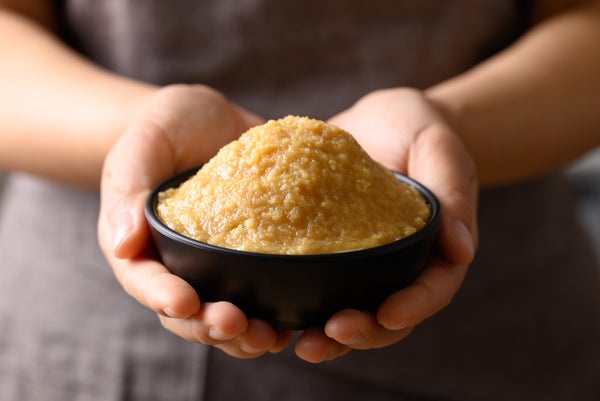
The savory, earthy condiment miso, common to Japanese cuisine, is made by fermenting cooked soybeans, salt and kōji, a type of mold from the fungus Aspergillus oryzae that grows on rice or barley. The process can be complex and surprisingly reminiscent of an experiment in microbiology, which makes it fitting that a cohort of scientists, bioengineers and culinary experts teamed up to ferment miso—in space!
Compared with Earth miso, “space miso” tastes nuttier, smells more pungent and is slightly darker, but “overall, the space miso is a miso,” conclude the researchers in findings published recently in iScience. The new study represents more than just a fun twist on the various microbe experiments conducted on the International Space Station (ISS)—fermenting space miso, it turns out, raises interesting questions about the role of microbes in humanity’s continued exploration of worlds beyond our own.

Researchers prepared a package of pre-fermentation miso to be sent to the International Space Station.
Jimmy Day (CC by-SA)
On supporting science journalism
If you're enjoying this article, consider supporting our award-winning journalism by subscribing. By purchasing a subscription you are helping to ensure the future of impactful stories about the discoveries and ideas shaping our world today.
Study co-lead author Maggie Coblentz, who conducted the research while at the M.I.T. Media Lab, was particularly intrigued by the nutritional possibilities of fermenting in space, as well as the possibility of expanding the flavors available to astronauts. Fermentation “offers astronauts greater autonomy, allowing them to take control over the foods they produce and manage their health and well-being in a way that is deeply personal,” she says.
From an astrobiological perspective, miso fermentation also “illustrates how life can thrive in space through the diversity of microbial communities,” Coblentz says. Miso taste and quality depends heavily on factors influenced by microbial activity—temperature, atmospheric pressure and light levels, among others—that all change dramatically in outer space. Although the primary objective of the study was to ferment edible, tasty miso in space, Coblentz and her co-lead author Joshua Evans were also intrigued by the slight differences in the resulting space miso’s microbial profile.
For example, the fungi in kōji mutated more often in space miso, potentially from increased cosmic radiation, says Evans, a food researcher at the Technical University of Denmark. Additionally, microgravity could have affected microbial growth and metabolism. Now that “we know fermentation in space is possible,” follow-up experiments could examine these hypotheses, he says.

After the miso fermented for 30 days on the International Space Station, it was returned to Earth, where the researchers sampled it in the lab.
Maggie Coblentz (CC by-SA)
Besides just being tasty, miso (and other fermented food) can also support gut health—so the result is good news for astronauts, says Jay Nadeau, an astrobiologist and physicist at Portland State University. Nadeau, who was not involved in the new study, notes that astronauts often have trouble staying healthy in space, not only because of the effects of microgravity but also because of changes in their gut microbiome.
“No one has looked at the diet very much, and I know that astronauts do talk about loss of senses of taste and smell,” Nadeau says. “They don’t really care about what they’re eating, although they do like strong flavors. And so I think it is really important to look at fermented foods as a source of both strong flavors and healthy microbiome.”
According to Coblentz, “Food diversity ... can enhance the well-being and performance of astronauts by catering to a wider range of tastes, dietary needs and cultural preferences.” Fermenting miso in space expands food diversity and also illustrates the complex microbiology of a seemingly sterile space station.
“When an astronaut travels to space,” Coblentz says, “they carry their own microbiome with them, and every material, plant and even food that accompanies them has a similar story to tell.”