
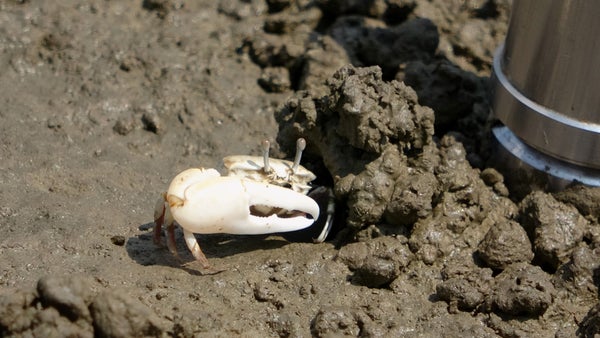
When male fiddler crabs try to attract a mate, they emit a series of vibrations and pulses by drumming on the ground—essentially a crustacean love song. It turns out that these crabs can produce fight songs as well, drumming a different tune to threaten a foe, researchers report in Animal Behaviour.
All sound waves begin with vibration. Human ears are built to detect vibrations or pressure waves traveling through air and water, which our brains perceive as voices or sounds. But many other animals “hear” sound through solid mediums—including the ground. Fiddler crabs primarily use sensory organs in their legs to detect the vibrations of sand particles.
To track the crab’s vibration-based soundtracks, researchers placed highly sensitive accelerometers in mudflats next to the crustaceans’ burrows on South Korea’s Yeongjong Island. Next, they introduced decoy female crabs made of polymer clay near the burrows.
On supporting science journalism
If you're enjoying this article, consider supporting our award-winning journalism by subscribing. By purchasing a subscription you are helping to ensure the future of impactful stories about the discoveries and ideas shaping our world today.
When courting, male crabs waved their large claw, then played a slow, long series of vibrations to lure these fake females into their burrows. Other times the crabs instead acted hostile to their clay counterparts and drummed out a shorter spurt of quick pulses to accompany defensive behavior. “I was surprised because I didn’t expect that they could make such complicated and sophisticated rhythms,” says study co-author Taewon Kim, a marine biologist at Inha University in South Korea.
This discovery illuminates the world of crustacean communication—and factors that could disrupt it, says Damian Elias, an animal behavior researcher at the University of California, Berkeley. For example, helicopters regularly flying over the study site created vibrations so strong that researchers were unable to record the fiddler crabs’ drumming and had to pause their experiment. Other human activities such as construction are known to disturb species that depend on ground vibrations, although scientists are still exploring the long-term impacts of these disruptions.
“It’s only recently that we really started to appreciate just how many animals communicate acoustically, particularly ones that don’t communicate using airborne vibrations in the way that humans detect them,” Elias says. “We need to think about how animals detect the world if we really want to understand them.”