
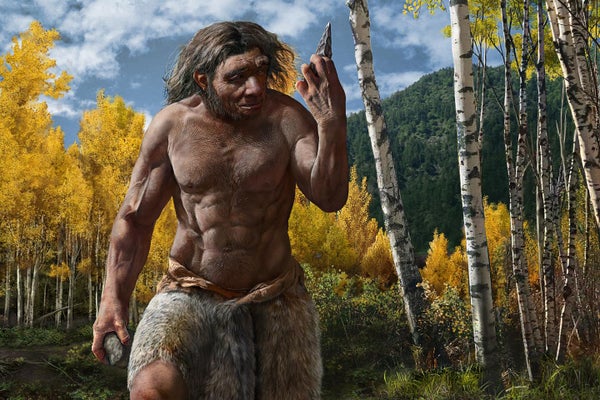
A prominent brow ridge with a brain as large as modern humans and Neanderthals — that’s what the archaic human group, the Denisovans, looked like, according to work published this week in Cell and Science.
Palaeontologists used ancient molecules to identify a cranium found near Harbin in northeastern China as belonging to the group. It’s the first time a near-complete skull has been definitively linked to the extinct people.
The fossil, which is at least 146,000 years old, ends a decade and a half of speculation about the Denisovans’ appearance. This had remained a mystery since scientists identified them from unique DNA taken from a finger bone found in a Siberian cave in 2010.
On supporting science journalism
If you're enjoying this article, consider supporting our award-winning journalism by subscribing. By purchasing a subscription you are helping to ensure the future of impactful stories about the discoveries and ideas shaping our world today.
“It’s really exciting to finally have Denisovan DNA from a nearly complete cranium,” says Janet Kelso, a computational biologist at the Max Planck Institute for Evolutionary Anthropology in Leipzig, Germany. “We finally have some insights into the cranial morphology of the Denisovans,” she says.
Dragon Man
The “massive” cranium — the upper portion of the skull, lacking the lower jawbone — is one of the best preserved of all archaic human fossils, according to researchers who first described it in 2021.
Qiang Ji, a palaeontologist at Hebei GEO University in Shijiazhuang, China, obtained the specimen from an unnamed man in 2018. The man — who Ji suspects discovered the artefact himself but failed to report it to authorities — claimed that his grandfather unearthed the fossil in 1933 during bridge-construction work over Long Jiang (which means dragon river), and buried it in an abandoned well, where it remained until a deathbed confession.
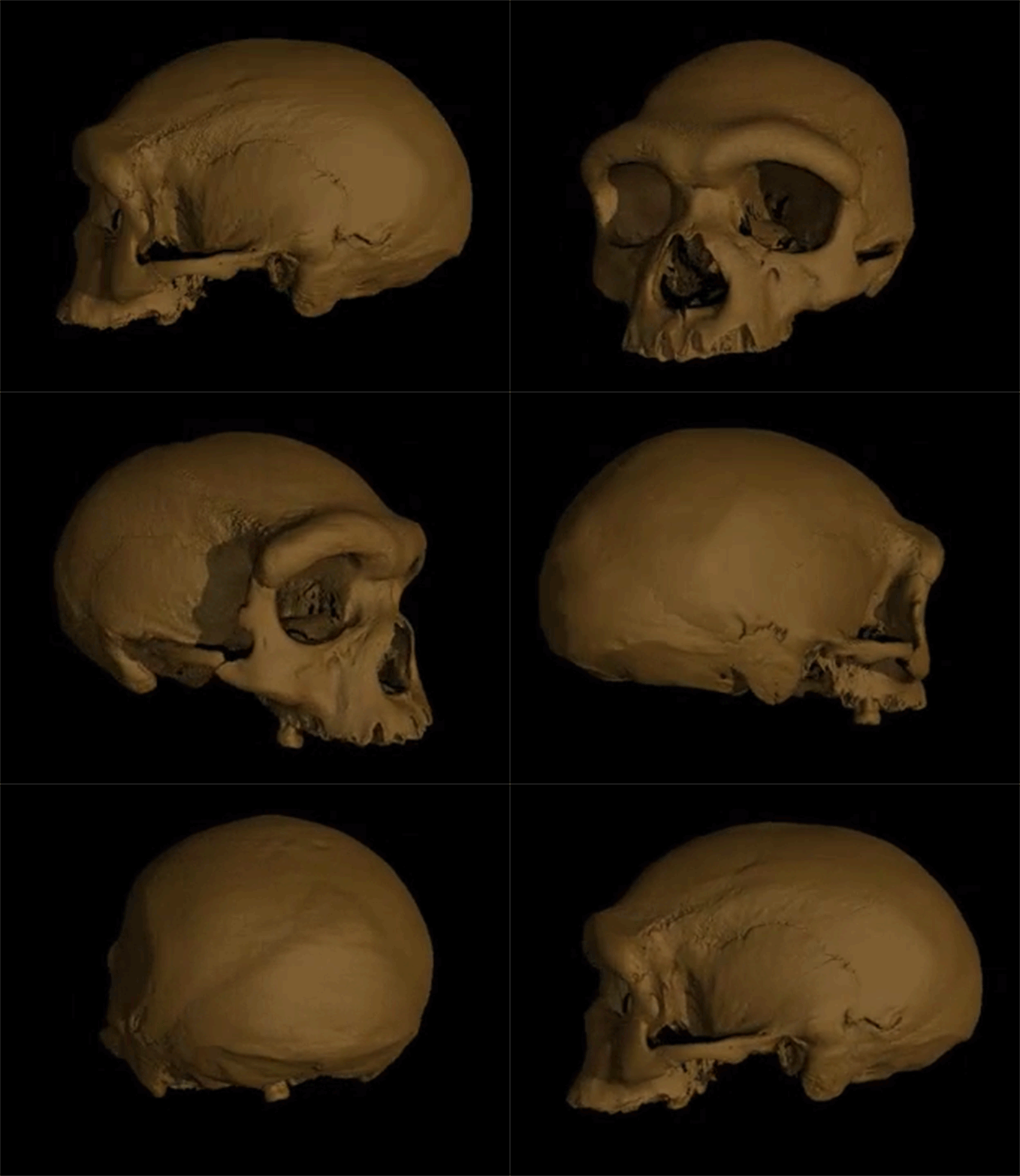
A virtual reconstruction of the fossil cranium found near Harbin, China.
Xijun Ni
In 2021, Ji and his colleagues determined that the ‘Dragon Man’ fossil represented a new archaic human species, which they crowned Homo longi.
Molecular sleuthing
When Ji published those findings, Qiaomei Fu, a geneticist at the Institute of Vertebrate Paleontology and Paleoanthropology in Beijing, got in touch. Fu worked on the very first Denisovan DNA from the Siberian finger bone and wanted to see whether the Dragon Man fossil contained any ancient molecules.
She and her team first attempted to extract ancient DNA from a part of the skull called the petrous bone — often a good source — and from an attached tooth. They didn’t recover any genetic material but did extract and sequence fragments from 95 ancient proteins from the petrous samples.
Fu compared these with Neanderthal, modern human and Denisovan sequences. One protein sequence from the Harbin fossil was identical to that of a protein from the Siberian finger bone, as well as from Denisovans uncovered in Tibet and Taiwan, but differed from proteins in modern humans and Neanderthals. That suggested the Dragon Man individual was a Denisovan. Fu’s team identified two further, less conclusive, protein matches.
It’s the second time this year that researchers have used ancient proteins to identify a fossil as Denisovan. In April, Takumi Tsutaya, a bioarchaeologist at the Graduate University for Advanced Studies in Kanagawa, Japan, and his colleagues identified a Taiwanese jawbone as belonging to a Denisovan. Tsutaya says that he was amazed to learn that another Denisovan has already been identified.
But Fu says that she wanted further evidence. She turned to a tiny chip of calcified dental plaque, or calculus. Fu looked for DNA from the host among the bacterial DNA in the sample. And she found it. Genetic sequences from the maternally inherited mitochondrial genome of the Dragon Man skull were most closely related to early Denisovans from Siberia, which were between 187,000 and 217,000 years old. Fu says that this is the first time that host DNA has been recovered from dental calculus from the Palaeolithic era, which ended 12,000 years ago.
Rikai Sawafuji, a geneticist at Kyushu University in Fukoka, Japan, who worked on the Taiwanese fossil, was surprised that the team recovered human DNA from the calculus, given that no DNA was recovered from the petrous bone. She says this could spur other researchers to analyse ancient plaque from Palaeolithic fossils. “If there is some dental calculus,” she says, “people can extract human mitochondrial DNA from those samples” to learn more about prehistoric human migrations.
Potentially more important is that scientists now have a Denisovan cranium that researchers can use to identify other Denisovan specimens in their collections, even if no ancient DNA or protein can be found.
This article is reproduced with permission and was first published on June 18, 2025.