
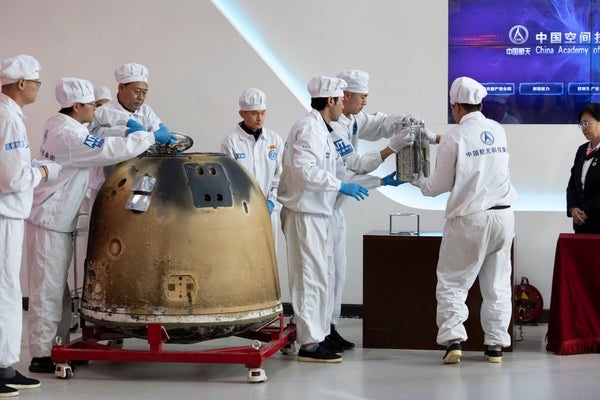
Researchers have had their first-ever look at samples brought back from the Moon’s far side — and the rocks detail a history of volcanic activity that spans billions of years.
The results are the first scientific analyses of samples retrieved by the Chinese mission Chang’e-6, which scooped up nearly two kilograms of lunar soil and returned it to Earth in a capsule in June. Independent research teams in China published separate papers in Science and Nature on 15 November.
“We can tell the story for a long history of volcanism and different mantle sources on the lunar far side,” says Qiu-Li Li, a researcher at the Chinese Academy of Sciences in Beijing and a co-author of the Nature paper.
On supporting science journalism
If you're enjoying this article, consider supporting our award-winning journalism by subscribing. By purchasing a subscription you are helping to ensure the future of impactful stories about the discoveries and ideas shaping our world today.
Dust to data
Chang’e-6 was China’s second mission to land on the lunar far side, after Chang’e-4 in 2019. Both landed in the South Pole–Aitken Basin, one of the Moon’s oldest and largest craters, which formed after a meteor impact nearly four billion years ago.

Moon rocks from the lunar far side reveal a history of volcanic activity.
Xinhua/Alamy Stock Photo
As expected, the researchers found that the fine dust — ranging from one to hundreds of micrometres in size — contained a mixture of grains from different geological epochs. The constant bombardment by micrometeorites and high-energy solar particles breaks up rocks into dust, which can then fly unimpeded by an atmosphere and land elsewhere, explains Yi-Gang Xu, a co-author of the Science paper, and a petrologist at the Chinese Academy of Sciences in Guangzhou.
By measuring isotope abundances, Xu and his collaborators found that a number of dust grains were from lava that erupted to the surface around 2.83 billion years ago. The other team’s findings were mostly similar, although the scientists also found lava grains as old as 4.2 billion years. These and other studies show that the Moon had active volcanism for billions of years before becoming the nearly still environment we see today.
This article is reproduced with permission and was first published on November 18, 2024.