
On February 22 “Mad” Mike Hughes died when his self-built steam rocket crashed shortly after takeoff. Hughes was a famous flat-earther, one of a growing group who do not accept that Earth is an oblate spheroid (which it is). His fatal launch was apparently general daredevilry and not an attempt to gather data for flatearthism. Although coverage by our friends at Space.com quoted him as saying in a 2017 documentary, “I'm going to build my own rocket right here, and I'm going to see it with my own eyes what shape this world we live on.”
Either way, Hughes's demise put flat-earth belief in the news briefly, which got me to dig out an interview I did last year with Michael Marshall, project director of the Good Thinking Society. The U.K. society has taken on the Sisyphean task of “encouraging curious minds and promoting rational inquiry.” And Marshall has become well versed in why on Earth people would believe it's flat.
“Some do believe it's a disk,” Marshall said. “But there's more than one way to think it's flat … some people believe that Earth is actually an infinite plane in all directions … and so when I first came across the flat-earth movement in 2013, this was quite a vociferous debate.”
On supporting science journalism
If you're enjoying this article, consider supporting our award-winning journalism by subscribing. By purchasing a subscription you are helping to ensure the future of impactful stories about the discoveries and ideas shaping our world today.
While those factions fought at conferences, other attendees were actually round-earth accepters who thought it would be fun to mix it up with the flat-earthers. Turned out it wasn't.
“And so they were stomping into these arguments, saying, well, what about photos of Earth from space and what about ships going over the horizon,” Marshall said, “not realizing that those were the first things [flat-earthers] thought about.” And they had convincing, if incorrect, responses. “And so [the flat-earthers] were winning those arguments … and in winning those arguments, they were converting even more people.”
Then, in 2016, some YouTube videos threw gasoline on the two-dimensional fire. Marshall said the video content was straightforward: “Proof number one: the horizon looks flat. Proof number two: even if you go up a mountain, the horizon looks flat. Proof number three: water can't stick to a curved surface. It always goes level, so there's no way it could stick to a ball. They're all very simplistic arguments.”
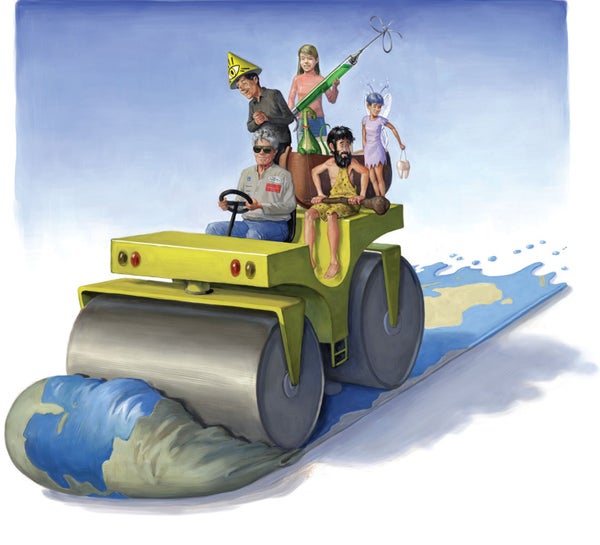
YouTube's recommendation algorithm appears to have then amplified the signal by bringing flatearth info to the attention of fans of other questionable notions. “So you'd be watching a video about moon-landing denial,” Marshall explained, “and YouTube would say, 'I think someone who's a bit into moon-landing denial might also be into the flat-earth theory.' And it would float it there as a suggestion. And if people clicked it, that solidified that link.” Flat-earth belief, quirky and perhaps humorous on its own, thus became part of what Marshall called “an ecosystem of conspiracy theory.”
“One thing that really surprised me at a convention I went to,” Marshall said, “was how little material was about the flat earth.” For example, he saw a presentation by a conspiracy theorist about the New World Order and the Illuminati. “But he was also pointing out how dinosaurs were faked.” The presenter tapped into the mother lode of conspiracy thinking by recommending a virulently anti-Semitic book that allegedly reveals what's really going on behind the scenes. Which reminds me, I have to wrap this column up so I can get to the Secret Jewish Cabal That Runs the Global Media meeting. (George Soros is serving hamantaschen!)
Not surprisingly, antivaccine material and other terrible health information are also passed around in conjunction with flat-earth ideas. Marshall recalled a convention speaker telling the assembled that “you can cure all manner of diseases, including HIV and AIDS, by drinking or injecting your own urine.” I would have thought that even someone who didn't know that Greek mathematician Eratosthenes nicely estimated Earth's circumference more than 2,000 years ago-proving that the planet was round-would consider urine injection to be a piss-poor idea.