New Issue: Orbital Catastrophe Ahead? Read Now

Flu Has Disappeared for More Than a Year

Mask wearing, social distancing and other steps to stop COVID-19 have also curtailed influenza

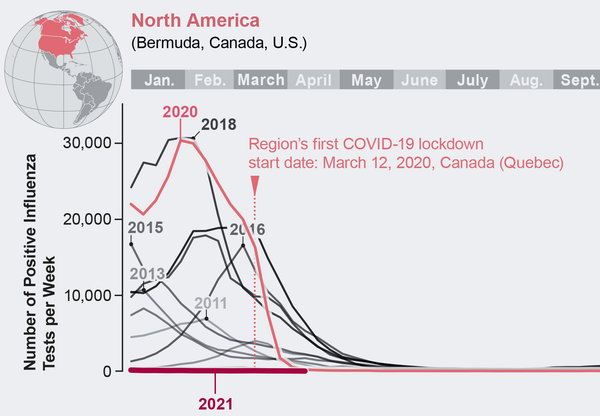
Line chart for North America shows a drop in positive flu tests concurrent with COVID lockdowns.

Katie Peek

Join Our Community of Science Lovers!

Since the novel coronavirus began its global spread, influenza cases reported to the World Health Organization from the Northern and Southern Hemispheres have dropped to minute levels. The reason, epidemiologists think, is that the public health measures taken to keep the coronavirus from spreading—notably mask wearing and social distancing—also stop the flu. Influenza viruses are transmitted in much the same way as SARS-CoV-2, the virus that causes COVID-19, and they are less effective at jumping from person to person.

As Scientific American reported in November 2020, the drop-off in flu numbers following COVID’s arrival was swift and global. Since then, cases have stayed remarkably low. “There’s just no flu circulating,” says Greg Poland, who has studied the disease at the Mayo Clinic for decades. The U.S. saw about 700 deaths from influenza during the 2020–2021 season. In comparison, the Centers for Disease Control and Prevention estimates there were approximately 22,000 U.S. deaths in the prior season and 34,000 deaths two seasons ago.

Credit: Katie Peek; Source: FluNet/Global Influenza Surveillance and Response System at the World Health Organization (data)

Because each year’s flu vaccine is based on strains that have been circulating around the world during the past 12 months, it is unclear how the upcoming 2021–2022 vaccine will fare should the typical patterns of infection return. The WHO made its flu strain recommendations in late February as usual, but they were based on far fewer cases than normal. Yet with less virus circulating, there is a reduced chance of mutation, so the upcoming vaccine could be especially effective.

Public health experts are grateful for the reprieve in cases. If the future includes more hand washing, face covering and temporary social distancing when people become sick, perhaps flu seasons can be less severe, even as health restrictions lift and groups gather together again.

Credit: Katie Peek; Source: FluNet/Global Influenza Surveillance and Response System at the World Health Organization (data)

Katie Peek is a science journalist and data-visualization designer with degrees in astrophysics and journalism. She is a contributing artist for Scientific American.

More by Katie Peek
Scientific American Magazine Vol 325 Issue 2This article was published with the title “Flu Has Disappeared Worldwide during the COVID Pandemic” in Scientific American Magazine Vol. 325 No. 2 ()
doi:10.1038/scientificamerican082021-1VswJ7jrwuw5rR6vdzFdO3

Subscribe to Support Independent Journalism

Great science journalism requires human expertise, time, effort and creativity. And it costs money. That’s why I and the journalists here at Scientific American hope you’ll join our community.

When you subscribe, you are supporting staff and freelance journalists who are passionate about telling science stories that are true, important and compelling. Our editors and reporters are often experts in their fields, which means they understand the nuances of big discoveries and can untangle the breakthroughs from the hype. With a subscription, you are also supporting rigorous fact-checking to ensure the words we publish are precise and accurate. And you’re supporting original illustrations, graphics and photos that bring you closer to an advanced laboratory, an ice sheet in Antarctica or a space mission in orbit. You’re helping us craft other types of high-quality journalism as well: Our newsletters are carefully written, edited and curated by staffers you have or will come to know and love. Our Science Quickly podcast is based on original reporting, collaboration with editors and scientists and exacting production.

Subscriptions keep this engine running so we can continue to deliver thoughtful, rigorous and independent science journalism to you. In an era of viral misinformation, this work is crucial. If you value what we do, I hope you’ll consider joining us as a subscriber

Thank you,

Jeanna Bryner, Editor in Chief, Scientific American

Subscribe