
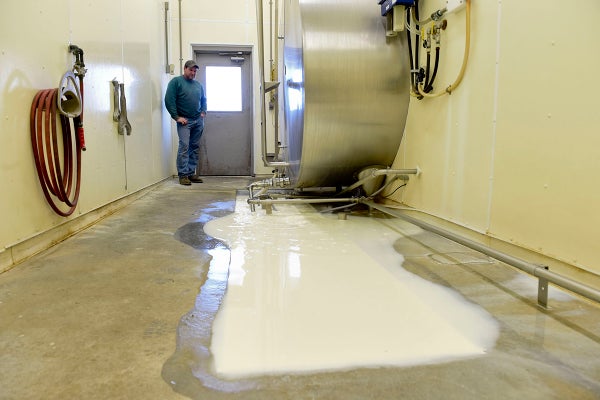
Videos showing floods of milk rushing down the drain circulated on social media this month, vividly illustrating the agriculture industry’s losses during the novel coronavirus pandemic.
After businesses and schools closed in response to social distancing measures, large-scale farms lost their normal customers and many had to throw out food. The breakdown of those dumped crops can create emissions that heat up the climate.
When food like a tomato is dumped into a landfill or piled up as waste, anaerobic processes break down the crop and release methane.
On supporting science journalism
If you're enjoying this article, consider supporting our award-winning journalism by subscribing. By purchasing a subscription you are helping to ensure the future of impactful stories about the discoveries and ideas shaping our world today.
“That’s the kind of food waste I think that is most alarming to people—is just seeing it dumped, and it, you know, just putrefying and then releasing more methane,” said Sean Pessarra, a 32-year-old farmer and horticulturist in Perryville, Ark.
Growing those crops in the first place generated its own emissions, so adding further emissions from waste is like “burning the candle on both ends,” said Pessarra, who works with Heifer USA, a nonprofit focused on teaching farmers how to make a living wage through sustainable agriculture.
Pessarra’s small-scale vegetable farm composts food that isn’t sold, which limits waste compared with a large conventional farm. But it has still sustained economic losses, including $4,000 worth of spinach and lettuce he expected to sell.
EPA estimates that the U.S. agriculture industry as a whole contributed 10% of total greenhouse gas emissions in 2018, including nitrous oxide, methane and carbon dioxide.
A Natural Resources Defense Council report in 2017 found that food waste accounts for at least 2.6% of greenhouse gas emissions in the United States, equal to the emissions from more than 37 million cars.
No one knows the exact impact of the recent dumping. EPA has said in the past that organic material discharged from dairy farms can break down into microorganisms that deplete oxygen in the water. That can harm marine life and, if it consumes all the oxygen, cause decay that releases its own methane.
Elizabeth Balkan, director of NRDC’s food waste, food and agriculture program, said the major climate impacts from food waste happen before that food is actually thrown out: “From the energy, the water and the resources that are used in the growing and manufacturing, distribution, storage and transportation of foods.”
Balkan used waste at a dairy farm as an example.
As milk is poured down a drain because it “couldn’t get to the consumer in time,” the wasted energy used during pasteurization and bottling leaves an “enormous greenhouse gas emissions footprint,” Balkan said.
One of the videos highlighted on social media came from Nikki Boxler of Boxler Dairy Farm in western New York.
“This week we got the call to start dumping milk because processing plants are full & there is no place for it to go due to the closure of restaurants, schools, and food services,” Boxler wrote in a tweet April 5.
‘Waste at a massive scale’
Many large-scale farms couldn’t adapt to the supply chain disruption in time to avoid tossing out their products.
“They can’t really retool quickly to turn those onions into 10-pound bags to send to a grocery store,” said Jennifer Kaplan, a food systems instructor at the Culinary Institute of America in St. Helena, Calif.
Large farms’ inability to get their products to consumers could lead to unprecedented waste, she said.
“There’s going to be a kind of food waste at a massive scale that I don’t think we’ve ever seen before, to be honest,” Kaplan said.
Although it would seem to be an obvious solution to send those crops somewhere like a food bank, that’s difficult, too, in the long term when there’s limited refrigeration capacity and labor shortages.
Pessarra said sustainable farming practices such as composting could help farms reduce both food waste and their climate impact, but that may take a long time.
“To set up that system this quickly ... it would just take too long,” Pessarra said.
Reprinted from Climatewire with permission from E&E News. E&E provides daily coverage of essential energy and environmental news at www.eenews.net.