
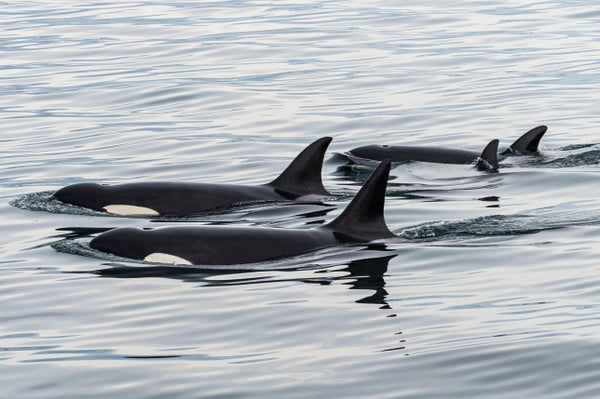
Northwest Pacific orcas have started wearing salmon hats again, bringing back a bizarre trend first described in the 1980s, researchers say.
Last month, scientists and whale watchers spotted orcas (Orcinus orca) in South Puget Sound and off Point No Point in Washington State swimming with dead fish on their heads.
This is the first time they've donned the bizarre headgear since the summer of 1987, when a trendsetting female West Coast orca kickstarted the behavior for no apparent reason. Within a couple of weeks, the rest of the pod had jumped on the bandwagon and turned salmon corpses into must-have fashion accessories, according to the marine conservation charity ORCA — but it's unclear whether the same will happen this time around.
On supporting science journalism
If you're enjoying this article, consider supporting our award-winning journalism by subscribing. By purchasing a subscription you are helping to ensure the future of impactful stories about the discoveries and ideas shaping our world today.
Researchers think the orcas sporting salmon hats now may be veterans of the trend when it first appeared nearly 40 years ago. "It does seem possible that some individuals that experienced [the behavior] the first time around may have started it again," Andrew Foote, an evolutionary ecologist at the University of Oslo in Norway, told New Scientist.
The motivation for the salmon hat trend remains a mystery. "Honestly, your guess is as good as mine," Deborah Giles, an orca researcher at the University of Washington who also heads the science and research teams at the non-profit Wild Orca, told New Scientist.
Salmon hats are a perfect example of what researchers call a "fad" — a behavior initiated by one or two individuals and temporarily picked up by others before it's abandoned. Back in the 1980s, the trend only lasted a year; by the summer of 1988, dead fish were totally passé and salmon hats disappeared from the West Coast orca population.
Orca researchers' best guess is that salmon hat fads are linked to high food availability. South Puget Sound is currently teeming with chum salmon (Oncorhynchus keta), and with too much food to eat on the spot, orcas may be saving fish for later by balancing them on their heads, New Scientist reported.
Orcas have been spotted stashing food away in other places, too. "We've seen mammal-eating killer whales carry large chunks of food under their pectoral fin, kind of tucked in next to their body," Giles said. Salmon is probably too small to fit securely under orcas' pectoral fins, so the marine mammals may have opted for the top of their heads instead.
Camera-equipped drones could help researchers monitor salmon hat-wearing orcas in a way that was not possible 37 years ago. "Over time, we may be able to gather enough information to show that, for instance, one carried a fish for 30 minutes or so, and then he ate it," Giles said.
But the food availability theory could be wrong — if the footage reveals that orcas abandon the salmon without eating them, researchers will be sent back to the drawing board.
Whatever the reason for the behavior, Giles said it's been fun to watch it come back in style. "It's been a while since I've personally seen it," she said.
Copyright 2024 LiveScience, a Future company. All rights reserved. This material may not be published, broadcast, rewritten or redistributed.