
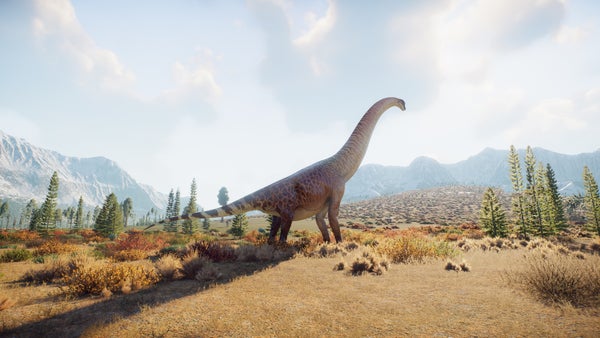
The Morrison Formation is a hotbed of dinosaur fossils. Spanning across much of the western U.S., this layer of rock dates to the Late Jurassic, some 163.5 million to 145 million years ago. It holds the remains of iconic dinosaurs, such as the armored Stegosaurus and the about 30-foot-long, meat-eating Allosaurus. Paleontologists have been digging through the formation since at least 1876. But only now are we getting a glimpse of how the dinosaurs that are found there interacted with one another while they were alive.
Sauropods—humongous reptiles with a long neck and tail and thick, elephantlike legs—played a starring role in the dinosaur ecosystem, according to a new study.
These massive dinosaurs are the largest creatures to ever walk on land. But they also played a crucial part in the food chain, the study authors write, acting as “ecosystem engineers.” The research was published on Friday in the New Mexico Museum of Natural History and Science Bulletin.
On supporting science journalism
If you're enjoying this article, consider supporting our award-winning journalism by subscribing. By purchasing a subscription you are helping to ensure the future of impactful stories about the discoveries and ideas shaping our world today.
By looking at fossil records from a section of the Morrison Formation in southwestern Colorado called the Dry Mesa Dinosaur Quarry, the researchers were able to reconstruct the dinosaur food chain across a several-thousand-year period of the Late Jurassic.
William Hart, now a graduate assistant at East Tennessee State University and one of the authors of the paper, compares sauropods to the elephants of today—these dinosaurs were “keystone” species, he says, creatures that had an outsized influence on its ecosystem.
Part of the reason why is that baby sauropods were easy pickings for predatory dinosaurs such as Allosaurus and Torvosaurus, another large meat eater. “Life was cheap in this ecosystem,” said Cassius Morrison, a Ph.D. candidate at University College London and lead author of the paper, in a statement. “The lives of predators such as the Allosaurus were likely fueled by the consumption of these baby sauropods.”
Sauropods are thought to have been voracious plant eaters, taking in heaps of vegetation to fuel their impressive growth—from eggs that were only a foot wide to full-grown adults that could weigh more than 15 tons.
Ultimately, the findings offer clues to how dinosaurs actually lived. “Reconstructing food webs means we can more easily compare dinosaur ecosystems across different periods,” Morrison said in the same statement. “It helps us to understand evolutionary pressures and why dinosaurs might have evolved in the way they did.”