
1968
Heart Attack Specialists
“The development of coronary care units promises a profound change in the treatment of patients with coronary artery disease. These units, although small and unpretentious facilities within a hospital, seldom exceeding eight beds, constitute a major therapeutic innovation in dealing with the inordinate mortality from heart attacks. Each year more than 1.5 million Americans suffer coronary attacks, and of these about 600,000 die. A person who suffers a heart attack and who is taken to a hospital that lacks a coronary care unit has no better chance for survival today than a person so stricken 30 years ago.”
On supporting science journalism
If you're enjoying this article, consider supporting our award-winning journalism by subscribing. By purchasing a subscription you are helping to ensure the future of impactful stories about the discoveries and ideas shaping our world today.
X-ray Crystallography
“A culmination of sorts has been reached in the past few years with the successful structural analysis of several of the basic molecules of living matter—the proteins—each of which consists of thousands of atoms held together by an incredibly intricate network of chemical bonds. The most recent success has been hemoglobin (by [Max Ferdinand] Perutz); the model of this protein contains 10,000 atoms. I confess that when I contemplate one of these models, I can still hardly believe that it has been possible to work out all its details by the optical principles of X-ray analysis, which half a century ago claimed sodium chloride as its first success. —Sir Lawrence Bragg”
Bragg shared the 1915 Nobel Prize in Physics with his father, William Henry Bragg, for x-ray crystallography.
1918
October Surprise
“In the enormous concentration of gun fire on the western front we have a reminder of the foul treachery of Trotzky [sic] and Lenine [sic], when these two German agents told the simple peasant soldiers of Russia to abandon the lines, since the war was over. They did so, leaving behind them along seven hundred miles of Russian front no one knows how many thousands of guns, big and little. This war material is now on the western front taking its toll of lives, French, British, and American. These two German agents also succeeded in handing over to Germany a whole fleet of warships, many of them among the latest and most efficient types, but we do not know how far the crazy revolutionists may have allowed the fleet in commission to deteriorate.”
1868
Drain the Swamp
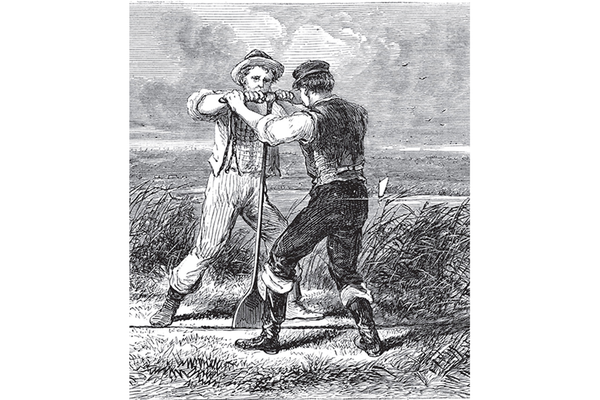
“The draining of swamp lands is not a new idea. Pumping, ditching, and the erection of dikes or levees are only partially successful. Water percolates through such artificial embankments; the rats and land crabs soon destroy their integrity. The iron dike invented by Mr. S. B. Driggs, of New York, seems to put an effectual barrier in the way of these destructive agents. It is constructed by driving iron plates into the soil and joining them end to end. The weight of workmen, or blows upon the tops with stones, is sufficient in very soft mucky soils, while when the turf is too tough and unyielding, it is cut by a process called chiseling [see illustration].”
The Wonderful Brain of Phineas Gage
“Nearly twenty years ago the medical journals of the world recorded a most singular case of a laborer in Cavendish, Vt., who while engaged in blasting had a tamping iron blown entirely through his head but who actually recovered within sixty days. Such a surprising and unprecedented result was generally disbelieved, many eminent surgeons pronouncing it a physical impossibility, but the subsequent public exhibition of the individual himself, convinced the most skeptical, and verified the first report of Dr. John M. Harlow, the attending surgeon who published the case. At a very recent meeting of the Massachusetts Medical Society, this gentleman read a paper giving a history of the case, and presented the veritable skull which sustained the injury. The man's general health appears to have been good until 1859. He was taken with epileptic fits which finally caused his death in May, 1861, almost 13 years after the accident. The effect of the injury upon the man seems to have been the destruction of the equilibrium between his intellectual faculties and the animal propensities. He became capricious, fitful, irreverent, vacillating, impatient of restraint, a child in mind, an adult in physical system and passions.”
.png?w=1350)