
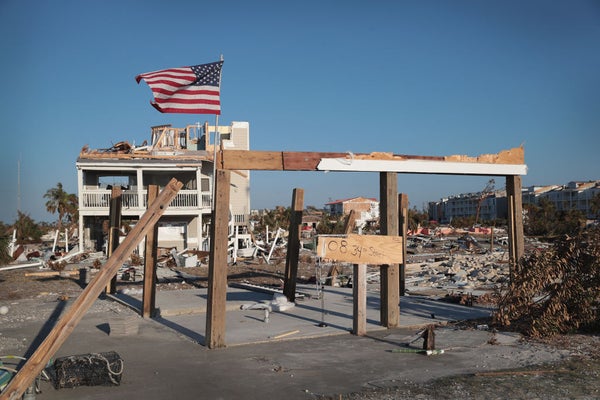
Four of the world’s 10 costliest natural disasters in 2018 occurred in the United States, accounting for nearly $53 billion in economic losses and 176 deaths, according to the global reinsurance firm Aon PLC.
Each of those U.S. disasters—two Atlantic hurricanes and two California wildfires—were influenced by climate change, said the experts who prepared the 84-page “Weather, Climate & Catastrophe Insight” report released yesterday.
“Weather events always occur, the question is are those events changing and what is the cause of that change?” said Steve Bowen, a Chicago-based meteorologist and director of Aon’s impact forecasting team. “The jury is still out as to how much you can quantify how climate change is affecting things monetarily. But especially since last year, we’re seeing a lot of these weather events influenced by a changing climate.”
On supporting science journalism
If you're enjoying this article, consider supporting our award-winning journalism by subscribing. By purchasing a subscription you are helping to ensure the future of impactful stories about the discoveries and ideas shaping our world today.
Globally, Aon tallied 394 natural catastrophes in 2018, generating economic losses of $225 billion. Of that total, private sector and government-sponsored insurance programs covered $90 billion, resulting in a 60 percent “protection gap,” the difference between total losses and insured losses.
The 2018 losses were lower than in 2017, when Aon tallied $438 billion in economic losses related to natural disasters, including three mega-events costing $50 billion or higher. Still, this year’s figure was the sixth highest for all disasters since 1980, and the 2017-18 period is the costliest on record, according to the report.
While 2018 did not bring a singular “mega-event,” there were 42 billion-dollar events, the cumulative effect of which is being felt by insurers around the world.
Andy Marcell, CEO of Aon’s Reinsurance Solutions business, said in a statement that the reinsurance industry continues to be able to meet its payout obligations and is backed by $595 billion in capital. But he said more attention should be paid to closing the protection gap.
Bowen said natural disaster risk is “evolving,” both in the United States and around the world, and will continue due to complex socioeconomic and demographic factors. But it’s clear that population and development pressures are increasing in parts of the world that are most vulnerable to catastrophic events, like coastal zones and forested areas.
Consider last year’s costliest and deadliest events.
Nine of the top 10 were associated with hurricanes, typhoons, floods and fires, including a weeklong deluge of torrential rain, floods and mudflows across central and southern Japan that caused $10 billion in damage and took 246 lives.
In the United States, October’s Camp Fire in Northern California killed at least 88 people and destroyed nearly 19,000 structures, including most of the city of Paradise. Total economic costs from the Camp Fire were estimated at $15 billion, according to Aon, making it the costliest fire in the state’s history.
Two other California fires—the Woolsey Fire in Ventura and Los Angeles counties in November and July’s Carr Fire in Shasta and Trinity counties—destroyed more than 3,200 structures and caused insured losses of $5.7 billion, according to the report.
The Insurance Institute for Business & Home Safety said in an insert to the report that the 2018 California wildfires “put an exclamation point on the frightening lessons” learned from the 2017 fire season, including that “wildfire risk extends well past the wildland urban interface (WUI) and reaches right into tidy suburban neighborhoods.”
The nation’s two costliest 2018 hurricanes, Florence and Michael, resulted in a combined 85 deaths and $32 billion in losses, according to Aon. Private or government-backed insurance covered less than half of those losses, with a wider protection gap in the Carolinas after Florence than in Florida and Georgia after Michael.
Michael was the first Category 3 storm to affect Georgia since 1898. It caused widespread damage to property, infrastructure and agriculture across the Southeast and extending into the Mid-Atlantic states, Aon said. Total losses from Michael were estimated at $17 billion.
Other 2018 disasters resulting in losses of $2 billion or more include:
Typhoon Mangkhut, a massive tropical storm that struck Guam, the Philippines and South China in September, causing 161 deaths and $6 billion in losses.
Typhoon Jebi, also in September, that hit Japan’s southeast coast, leading to 17 deaths and $13 billion in economic losses.
A series of typhoon season storms and floods in India’s Kerala state, killing more than 1,400 people and causing $4.4 billion in losses.
A prolonged summer drought across much of northern and central Europe that resulted in $9 billion in losses, mostly in the agriculture sector.
Severe weather and flooding in Italy and Austria during October and November, with an economic toll of $5 billion.
Windstorm Friederike, the fifth-costliest European windstorm since 2000, resulting in $2.1 billion of insured losses.
Reprinted from Climatewire with permission from E&E News. E&E provides daily coverage of essential energy and environmental news at www.eenews.net.