
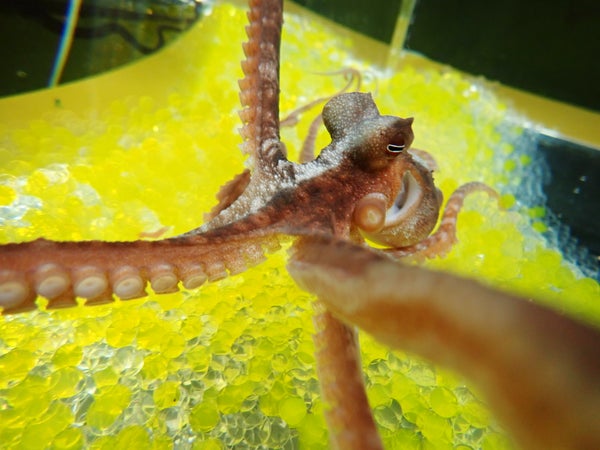
In the classic “rubber hand” illusion, a participant is tricked into experiencing a fake arm on the table in front of them as their own: their brain “feels” the tickle of a feather or other stimuli they see applied to the fake arm. (The real arm is behind a partition.) Until now, only some mammals, such as humans and mice, were known to be susceptible to this illusion. But a recent study in Current Biology shows that octopus brains can be tricked in the same way, adding another wrinkle to what we know about these creatures’ inner lives.
First the scientists placed an octopus in a water tank where it could relax on a soft substrate similar to the seafloor. Then they inserted a partition that covered one of the octopus’s arms and left a fake one visible instead. “It was important to make the rubber arm look like the octopus’s real arm because in the human experiment, the illusion does not occur if the fake hand is shaped differently from the real human hand,” says study lead author Sumire Kawashima, a biologist at the University of the Ryukyus in Japan.
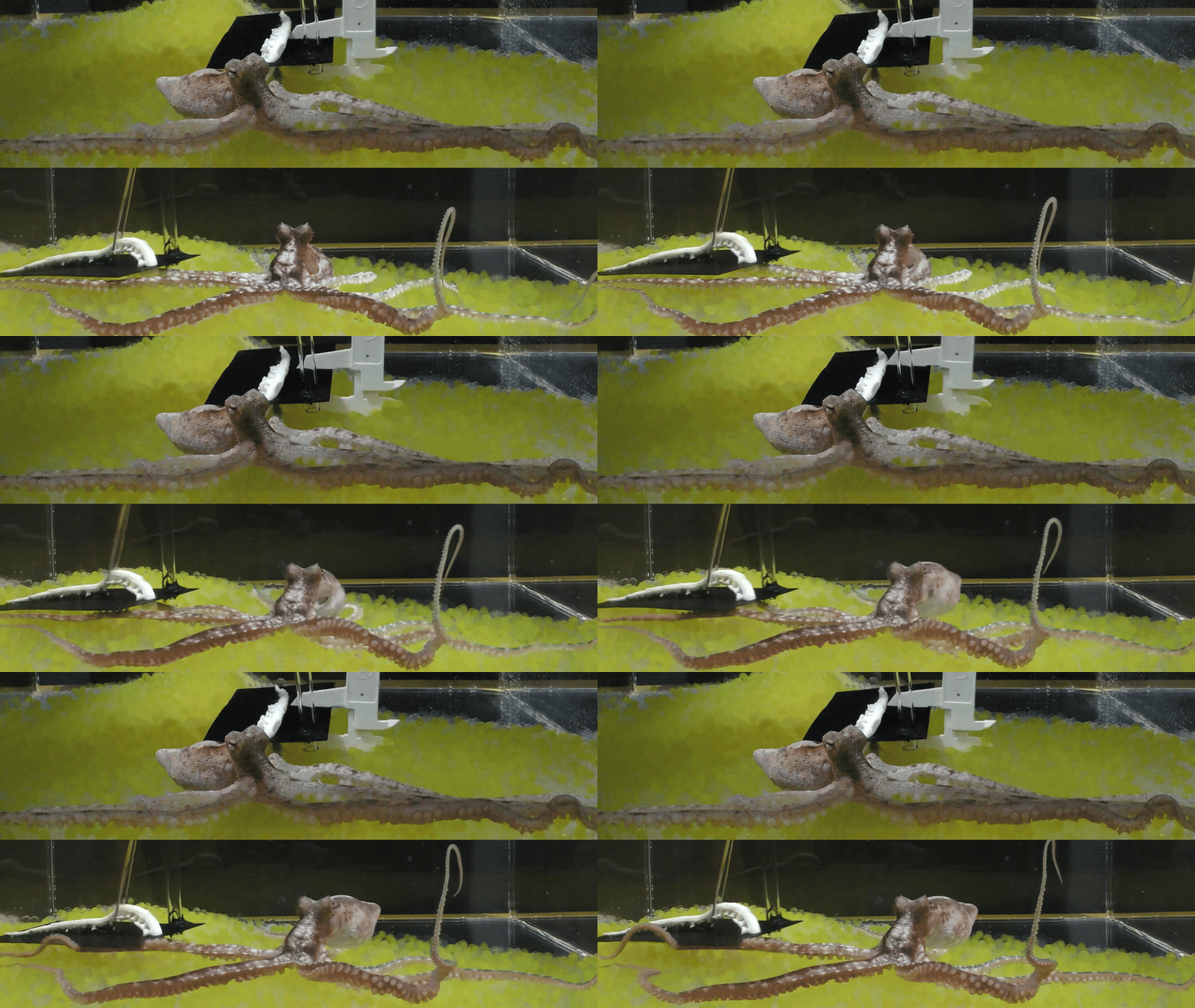
In the top video the octopus does not react to the fake arm being gently touched by a caliper, but in the lower video it does respond to strong grasping with tweezers.
Sumire Kawashima
On supporting science journalism
If you're enjoying this article, consider supporting our award-winning journalism by subscribing. By purchasing a subscription you are helping to ensure the future of impactful stories about the discoveries and ideas shaping our world today.
Next the researchers simultaneously stroked the real and the fake arm with tweezers. After about eight seconds, they went on stimulating only the fake arm. All six octopuses that met the researchers’ test conditions reacted to the fake arm’s stimulation with defensive responses such as escape maneuvers or body color changes. But when the experimenters tried different approaches such as stroking only the fake arm or stroking the arms asynchronously, the octopuses “were not surprised at all,” says study co-author Yuzuru Ikeda, also a biologist at University of the Ryukyus.
The findings suggest octopuses fall for the same illusion as humans—and thus may have a sense of body ownership like we do, the researchers say. And the octopuses’ susceptibility to the illusion is an interesting result in itself because such perception is also one of humankind’s “very advanced abilities,” Ikeda says.
“I hadn’t seen anything like this before,” says Kristin Andrews, a philosopher at York University in Toronto, who studies animal minds. She says the study seems to offer evidence that octopuses are “self-conscious” or aware of their bodies, although “we can’t assume that octopuses have the same intuitive belief in a separation between a core self and the body that humans seem to have. [They] might see the world in a very different way.”