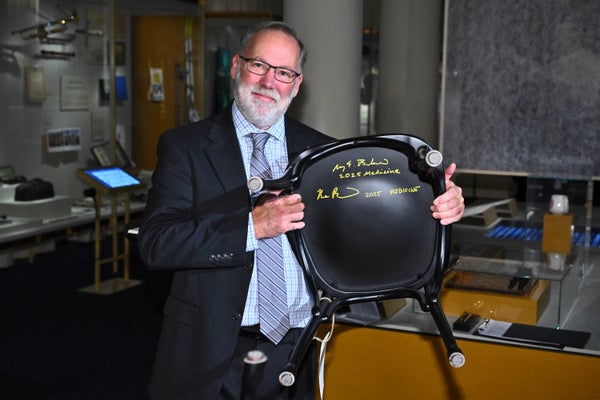
Fred Ramsdell is an immunologist and biotechnology entrepreneur who won the 2025 Nobel Prize in Physiology or Medicine with Mary Brunkow and Shimon Sakaguchi for their work in understanding autoimmunity and inflammation. He is a scientific adviser for Sonoma Biotherapeutics.
[This interview was edited for length and clarity.]
How would you describe the current state of American science?
On supporting science journalism
If you're enjoying this article, consider supporting our award-winning journalism by subscribing. By purchasing a subscription you are helping to ensure the future of impactful stories about the discoveries and ideas shaping our world today.
Challenging. I don’t think, in my professional career, we’ve had the level of disconnect, I would say, between what science is doing and public perception of science. [But] it’s not the first time. We've always had challenges. I actually read a speech from a colleague of mine from 1999–2000 where he complained about this very issue.
I think it is problematic, in part, because we, as the science community, have not been particularly good about communicating, and we have to, in my view, get back to a place where there is some level of trust and understanding—because if there’s no trust, why would you fund science? I don’t want to fund stuff with my tax dollars that I don’t trust.
How did we get to that point? I’m not sure. COVID, I think, certainly helped accelerate any underlying issues that existed. I think the scientific community didn’t do a great job in communicating and explaining and discussing what was going on and admitting, at times, when we had to pivot and make changes, right? It was a very dynamic situation, but I don’t think that's the entire reason for this. I won’t speak for physicists and chemists; they can talk for themselves. But certainly [in] the biomedical fields, I think, we have a big disconnect right now. And I think, if you want to take an economic view, a geopolitical view, the U.S. has led the planet for the past 100 years—in this field, 50 years—and we are at great risk of losing that leadership position. And I think that would be a mistake for us at many levels.
What needs to change in American science?
American scientists need to be much better communicators to people who aren't scientists.
People come up to me and say we can’t cure cancer. Bullshit. We can cure cancer but not all cancers and not [in] all people. I couldn’t say that 25 years ago, right? Minus some surgical interventions, that was not something you could say. That’s amazing progress in 25 years. People need to know that.
We need to be much better at describing what we know and what we don’t know and what we think we know, and we’re just not good at that. And this goes back to the fact that, over time, the message changes. And often the message changes because the data change; we learn something. What I think happens is: it comes off as “You guys don’t know what you’re talking about. You keep changing your message.” Well, it’s because the information changes.
The idea that Americans can’t handle or understand change is silly, but we need to be really honest about what we do and don’t know. And, you know, there’s a segment of the population that will want certainty and perfection—that’s going to be a problem forever. But whatever, most people are more rational than that.
As an example, I spend half my time in Montana. I’m flying from Seattle back to Montana to talk to the Flathead Valley Community College in about a month because I think it’s a really interesting opportunity to have a discussion with people in a community that isn’t anchored [by] or doesn’t have a major biomedical presence. This is a place that just doesn’t have that industry, doesn’t have that field, and so there’s very little exposure to what we do. So I will spend time there, talking to people, answering questions, providing perspective, etcetera, as much as possible.
The longest interview I’ve given was to the Flathead Beacon. I spent an hour and a half with the with the woman [who interviewed me]. One of the comments I made was that winning the Nobel Prize really messed up my hunting season in Montana. And, you know, most people [at] the BBC and NPR and in Boston and San Francisco, that’s not going to resonate, but it will for everybody in Montana. Right now I’m trying to do my little bit, but, you know, it’s a start, and we need a more concerted, scalable, effective way to have this kind of dialogue.
What gives you optimism right now?
A couple of things. One, this isn’t the first time we've been through this, as I mentioned. So everyone thinks the world is falling apart. I swear, every two years, we hear this is the most important election of our life, and I know I’m going to hear that again, and I guess they all are until we die. But, you know, the crying wolf thing is problematic because, generally speaking, intelligent, rational views prevail. Not everyone agrees what the definition of “intelligent and rational” is, I do get that. Times go up and down for sometimes self-inflicted reasons, sometimes geopolitical or economic reasons. But I think, overall, things have been good.
Two is meeting a lot of young, budding scientists. I can say I’m really happy I’m not trying to get into graduate school right now—I would probably not make it. People are really smart, and they’re very motivated to use the tools they have today that we didn’t have. And people can integrate a lot of information. It’s not the technology so much that give me hope; it's people’s ability to be creative and use technology and use knowledge and use information in useful ways.
If you were given a $100-million grant that didn’t require any preliminary data or guaranteed milestones, what high-risk project would you start?
Well, I don’t know that I would start it, but ultimately, fusion energy. If you can make this planet not dependent on fossil fuels and even wind, I think that would change the trajectory of every country and every person on this planet. So I would I think fusion is the thing that we need to do.
What’s your best advice for an early-career scientist?
I hate giving advice. The only advice I ever really give people is to pay attention. So sometimes that means get off your damn phone. And as everyone knows now, mine is on airplane mode. I’m not exactly a Luddite, but I’m a little extreme on this. But it’s not just that. It’s: If you're having dinner with your spouse, have dinner with your spouse. Don’t think about what you got to do tomorrow or who you pissed off yesterday or who pissed off you two days ago. Be in the moment.