
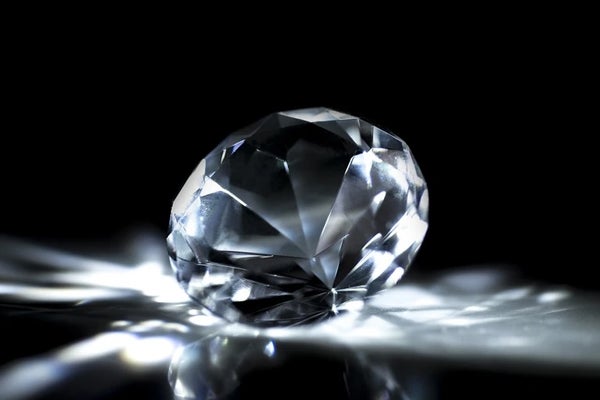
Diamond is famously known as the hardest mineral on Earth. But researchers have been pursuing an unusual variant of it — known as hexagonal diamond — that might be even harder. After decades of claims and counterclaims about whether this mysterious material can be synthesized in a laboratory, researchers in China report that they have done it.
Scientists covet the material because it “has potential applications in many fields, for example in cutting tools, in thermal management materials and in quantum sensing,” says Chongxin Shan, a physicist at Zhengzhou University, who co-led the work.
“There are hundreds of claims from people who believe they have seen it,” says Oliver Tschauner, a mineralogical crystallographer at the University of Nevada, Las Vegas, who peer-reviewed the paper. “But this is the first very accurate characterization of this elusive material.”
On supporting science journalism
If you're enjoying this article, consider supporting our award-winning journalism by subscribing. By purchasing a subscription you are helping to ensure the future of impactful stories about the discoveries and ideas shaping our world today.
Shock value
Conventional diamond consists entirely of carbon atoms arranged into tetrahedra, which ultimately form a cubic crystal structure. Viewed from a specific angle, this lattice of atoms looks like a stacked series of buckled honeycomb layers. Each successive layer is offset slightly relative to its neighbours, in a pattern that repeats every three layers. But in 1962, researchers predicted that diamond could adopt a different structure — one with hexagonal features — in which the pattern repeats every two layers.
In conventional, or cubic, diamond, the carbon bonds between layers are marginally weaker than those within layers, which limits diamond’s strength. In the hexagonal form, the bonds between layers are shorter and stronger than those in cubic diamond, and predictions suggest that these features should make hexagonal diamond more than 50% harder.
In 1967, researchers reported finding hexagonal diamond in a meteorite found in Arizona, which was part of the space rock that created the iconic Meteor Crater nearby. The team suggested that the shock of the impact had transformed graphite in the meteorite into hexagonal diamond, and named this new mineral lonsdaleite, after pioneering crystallographer Kathleen Lonsdale.
Around the same time, a separate research team said that it had produced hexagonal diamond in the lab by heating and compressing graphite. But some scientists have cast doubt on that report. And others argued that lonsdaleite wasn’t hexagonal diamond at all; they said it was just cubic diamond with several defects.
Peak demand
Much of the debate stems from the X-ray diffraction experiments used to discern the material’s crystal structure, Tschauner explains. In this type of experiment, as X-rays scatter through a crystal, some of them combine and produce peaks in X-ray intensity that reveal atoms’ positions. However, the pattern of diffraction peaks obtained from highly defective cubic diamond would closely mimic hexagonal diamond, Tschauner says. To demonstrate the hexagonal structure conclusively, a few extra telltale peaks must be present. “This new paper shows those peaks,” he says. “That’s why I believe it.”
Shan and his colleagues started with highly oriented pyrolytic graphite, and then squeezed it in between anvils made of tungsten carbide under 20 gigapascals of pressure (200,000 times atmospheric pressure) at 1,300–1,900 °C to produce millimetre-sized samples of hexagonal diamond. Tests showed that the material was stiffer, more resistant to oxidation and slightly harder than cubic diamond.
Last year, another research group independently reported making hexagonal diamond. “It looks like the new paper is very similar to ours. I have to say, I cannot see any difference,” says Ho-kwang Mao, a physicist who is the director of the Shanghai Advanced Research in Physical Sciences centre in China, and who led the team involved in the 2025 paper. “But we’re glad they have reproduced our results.”
Hex signs
“It is almost the same,” says Tschauner, pointing out that the X-ray analysis by Mao and his colleagues lacked one or two of the diffraction peaks that are expected to be seen in hexagonal diamond. A third group also reported in 2025 that it had made “nearly pure” hexagonal diamond that was harder than cubic diamond.
Mao says that tiny traces of cubic diamond that contaminated the samples produced by both his group and Shan’s could explain why their hexagonal diamond is not as hard as predicted. “If we can get rid of all that, we can probably make it even harder,” he says.
Taken together, these papers should be enough to convince hexagonal diamond sceptics that the material exists and can be made in the lab, Shan says.
The work might also reinvigorate the search for genuine hexagonal diamond in meteorites, Tschauner says, because it proves that the material can be created by pressures and temperatures that are consistent with meteor impacts. “I think we need to figure out if it actually really exists in nature,” he says. “For meteorite research, the quest is now to find it.”
This article is reproduced with permission and was first published on March 4, 2026.