
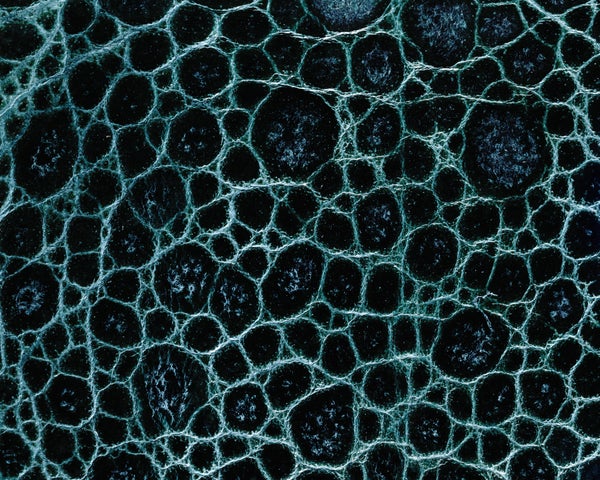
Looking deep within mammalian spit-producing glands, scientists were recently surprised to find an ancient cell type long thought to exist primarily in the slimy skin of frogs and fish. Such discoveries are rare in modern science—and researchers say these tiny cells could fill many more roles than previously thought.
The scientists were trying to determine which cell produces a certain protein involved in salivary gland growth and repair. Using a technique called single-cell RNA sequencing, they isolated candidate cells from mouse glands and then examined their genetic function. They found the gene for the salivary gland growth protein—and discovered that the cells producing it were ionocytes, a specialized cell type that pumps charged particles across membranes. “It is a very, very interesting cell,” says Helen Makarenkova, a molecular medicine researcher at the Scripps Research Institute and co-author of a Cell Reports study on the finding.
Historically, Makarenkova says, “people didn't really pay much attention to the ionocyte.” The cells were well documented in frog and fish skins, where they help to maintain a healthy salt balance in aquatic environments. In 2018 researchers learned that a version exists in humans, too: Harvard University scientists unexpectedly found ionocytes in human lungs' lining. In retrospect, it made sense for the cells to be useful in this kind of moist, permeable tissue, says systems biologist Allon M. Klein, who was on that team and was not involved in the new research. “Frog skin looks very much like the [human] airway,” Klein says.
On supporting science journalism
If you're enjoying this article, consider supporting our award-winning journalism by subscribing. By purchasing a subscription you are helping to ensure the future of impactful stories about the discoveries and ideas shaping our world today.
The researchers suggest salivary gland ionocytes probably regulate saliva pH and viscosity and secrete the growth factor that is crucial for salivary gland repair. Although the cells have not yet been directly observed in human salivary glands, the growth factor they produce has been isolated in human saliva.
But how did scientists overlook mammalian ionocytes for so long? For one thing, single-cell RNA sequencing has been available only for about a decade, and it remains relatively expensive. Plus, ionocytes are physically small—about a quarter of the size of most mammalian cells—and few in number. “As compared with the major constituents of the tissue,” Klein says, “they are rare.” Still, he speculates that they might lurk in other mammalian tissues, such as intestinal lining.
Makarenkova's next steps are to confirm ionocytes' existence in human salivary glands and to investigate their potential to treat conditions such as dry mouth, in cases where the cells are insufficient or dysfunctional. And she would like to search for ionocytes in other tissues and investigate their function: “This might be quite a general mechanism.”