
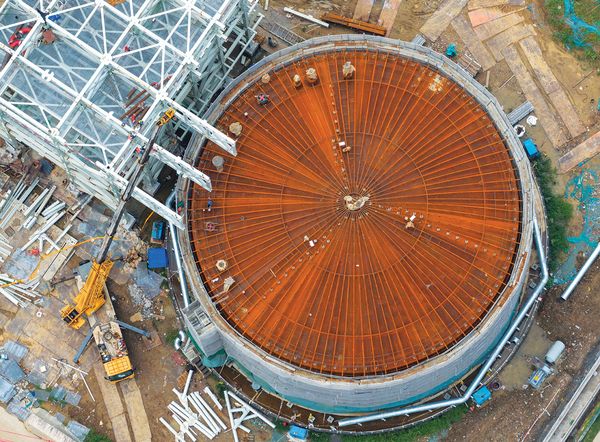
Two decades ago renewable energy was a bit player on the world stage. Today renewables account for nearly half of all global electrical capacity, according to the International Renewable Energy Agency, and there’s a lot more in the pipeline. It’s a stunning surge showing that the renewable revolution appears unstoppable. Clean energy still faces challenges, though. To meet them, countries and companies are taking some big swings to push this revolution into a new phase—with ambitious projects that may or may not pan out.
One of the most significant problems is that solar and wind are intermittent, and the lithium-ion batteries currently available can’t store enough energy from renewables to reliably meet demand. To squeeze the most juice out of solar and wind, we need longer-term storage, leading some in the industry—notably in China—to reach for a technology that has been shelved for decades. Chinese companies are also pushing the limits on how large and how far offshore turbines can be so they can take advantage of steadier, stronger winds. Other ventures are trying to broaden the appeal of geothermal energy and crack the code on tidal power, one of the biggest untapped sources of power on the planet. Here are some of the most audacious of these projects. —Andrea Thompson
On supporting science journalism
If you're enjoying this article, consider supporting our award-winning journalism by subscribing. By purchasing a subscription you are helping to ensure the future of impactful stories about the discoveries and ideas shaping our world today.
Geothermal Energy for (Almost) Anywhere
Pulling heat from the earth without perfect geology
Name of project: Fervo Energy’s Cape Station
Location: Utah
Name of technology: Enhanced geothermal systems (EGS)
Power generation: A projected 100 megawatts by early 2027, with 500 megawatts in total under construction
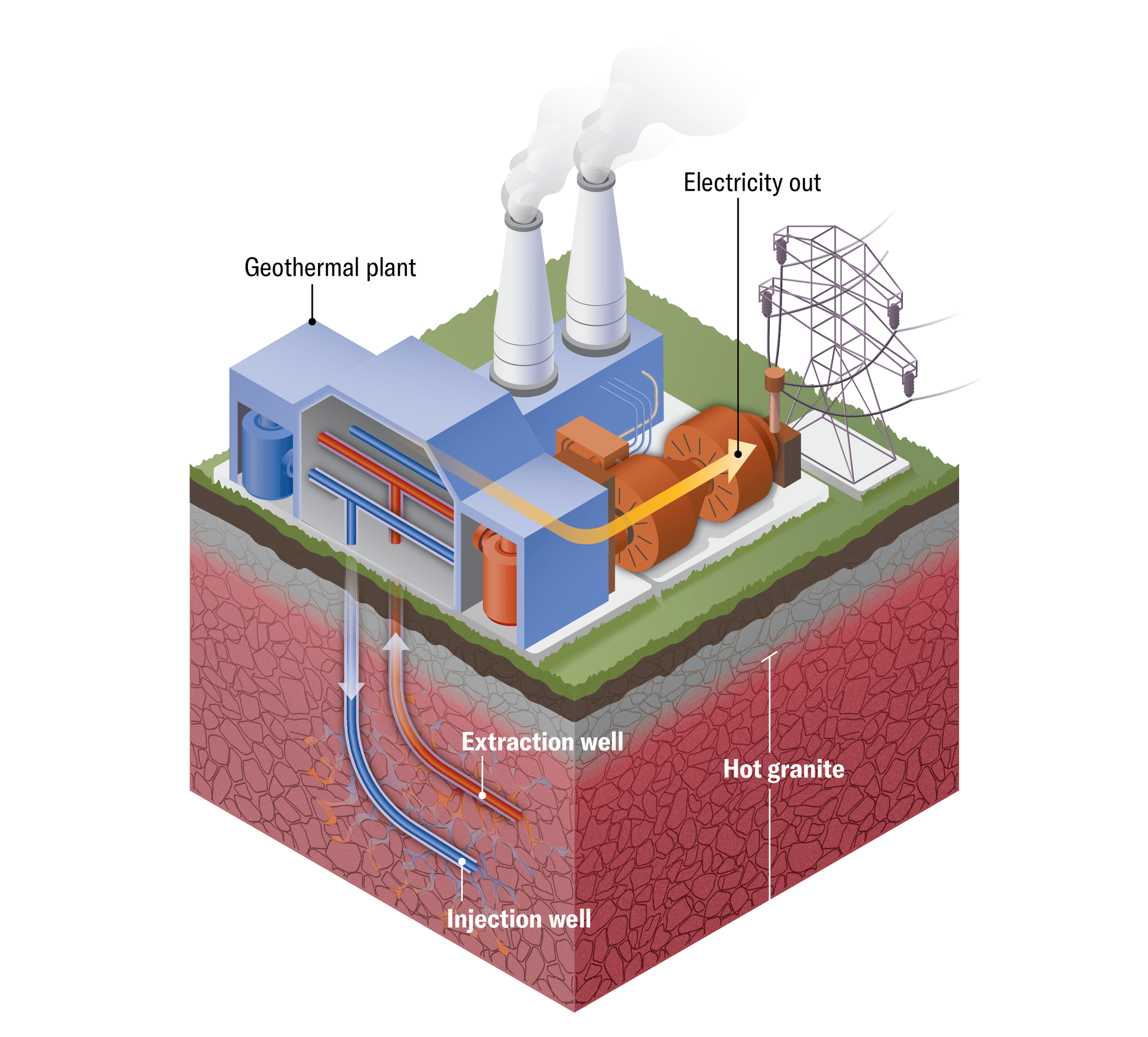
How it works: Fervo drills down and then sideways, creating a network of long fractures in rock as deep as almost 2,750 meters (although future depths may vary); it then pushes water through these cracks to draw heat out of the earth. The large network of fissures exposes much more water to much more hot rock than single-pipe geothermal setups do, increasing efficiency. To execute the design, Fervo has translated oil and gas fracking’s pressurized fluid injections from softer sedimentary shale rock to hotter, harder volcanic rock. (Experts say seismic monitoring is advanced enough that work can be paused if risks of quakes above magnitudes people can feel rise too high.) At a demonstration facility called Project Red, Fervo connected test wells to a preexisting power plant, where it has been generating three megawatts of power since late 2023.
Why it’s needed: Unlike solar and wind, geothermal energy can be used 24/7. But to be economical, traditional geothermal requires perfect geology: hot rock that water naturally passes through and a reliably recharged water source to keep the heat flowing. This necessity has limited its use to a handful of spots on Earth. By adding fractures, EGS creates more places where geothermal is economically feasible. Other companies have targeted different geothermal strategies, and geothermal has been met with a wave of enthusiasm from the U.S. government.
What the experts say: Jefferson Tester, a Cornell University engineering professor, says he’s excited by the work Fervo is doing but worries that the company might have promised its funders too much too soon. “You’ve got to prove that this thing actually works for a sustainable period of production,” he says. “The proof will come only with what you find out in the field.” (Fervo Energy did not reply to interview requests.) —Meghan Bartels
Nick Bockelman
The Power of the Tides
Predictable motions of the ocean can provide reliable, renewable energy
Name of project: MeyGen
Location: Scotland
Name of technology: Tidal stream energy
Power generation: Six megawatts (increasing to 65 megawatts by 2031)
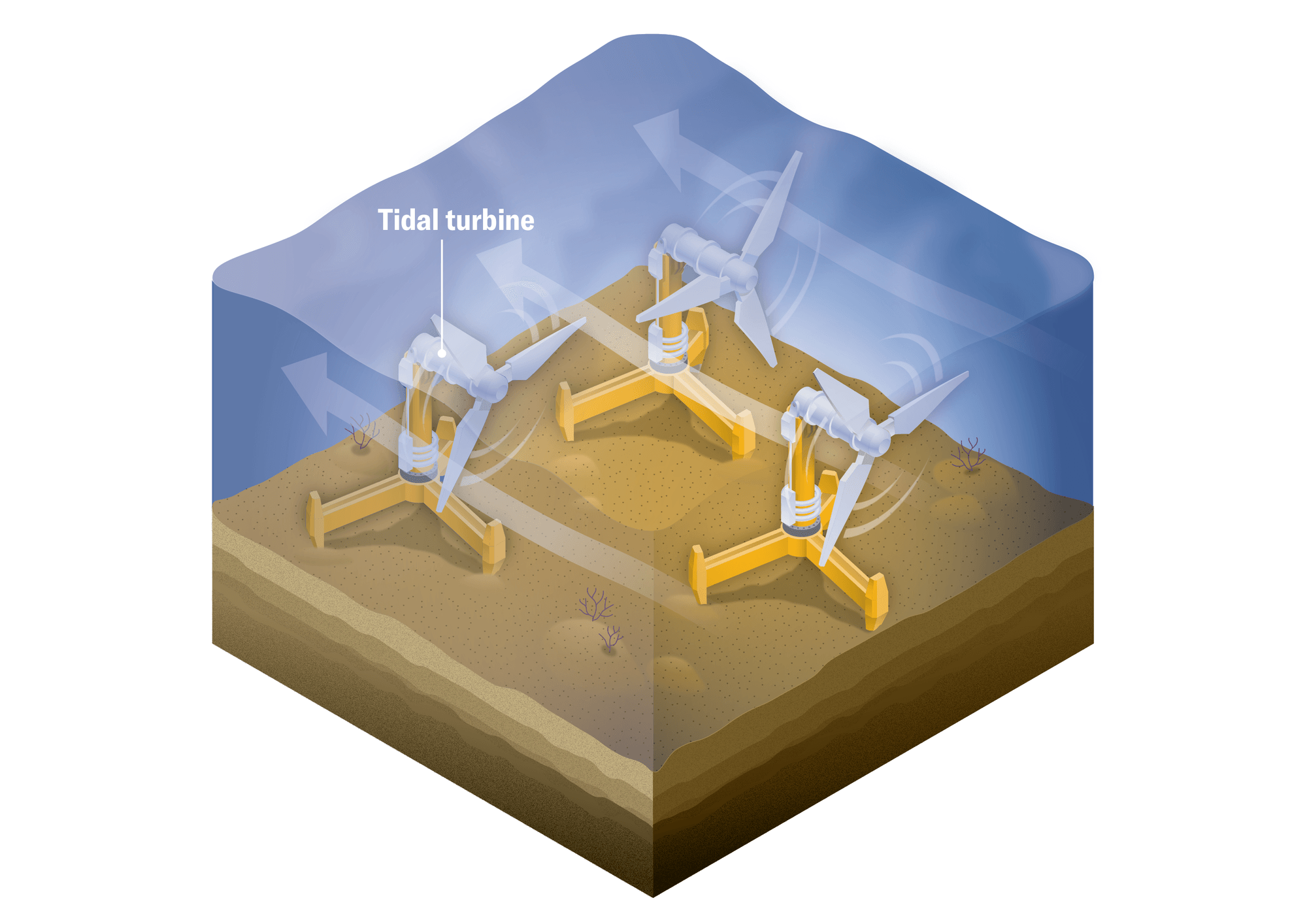
How it works: Since 2016, MeyGen, located between the Scottish mainland and the Orkney Islands, has been the world’s largest tidal stream energy project. It exploits the fact that the tides that ebb and flow along our planet’s coastlines carry tremendous energy, with a harvestable potential estimated at 1,200 terawatt-hours per year, more than a quarter of annual power generation in the U.S. That energy can be harnessed in much the same way that wind farms harness moving air. “In very simple layman’s terms, you’re putting a wind turbine underwater,” says Drew Blaxland, CEO of Proteus Marine Renewables, which developed MeyGen’s four 1.5-megawatt turbines. The turbine blades spin with each incoming and outgoing tide, capturing the ocean’s kinetic energy to power a generator that produces electricity.
Why it’s needed: Unlike other renewable energy sources, tides are highly predictable. “We can tell at any point in time, any day, exactly how much energy we’re producing,” Blaxland says, “which you can’t do with wind or solar.” Tides are as brutal as they are reliable, though; saltwater corrosion, ocean debris and the sheer force of rushing water often cause turbines to fail. But one of MeyGen’s turbines has reached a major milestone in performance, running for more than seven years without unplanned maintenance. Built on massive foundations and equipped with blades that adjust to align with the tide, the turbines are engineered to withstand extreme, fast-flowing marine currents. MeyGen plans to add 20 turbines by 2031, boosting its capacity to 65 megawatts. According to Ampeak Energy, which owns the project, the site could ultimately produce nearly 400 megawatts.
What the experts say: Although tidal energy will always be limited by geography and is unlikely to catch up to wind and solar anytime soon, it could account for 10 percent of the U.K.’s energy needs, Blaxland says. “They’ve had a great track record of long-term generation from multiple large machines,” says Brian Polagye, a mechanical engineer at the University of Washington who specializes in marine energy. “The hyperbole is well deserved.” —Cody Cottier
Nick Bockelman
Energy from Thin Air
With the need for long-term energy storage rising, a technology from the 1970s steps back into the limelight
Name of project: Huai’an Salt Cavern
Location: China
Name of technology: Compressed air energy storage
Power generation: 600 megawatts
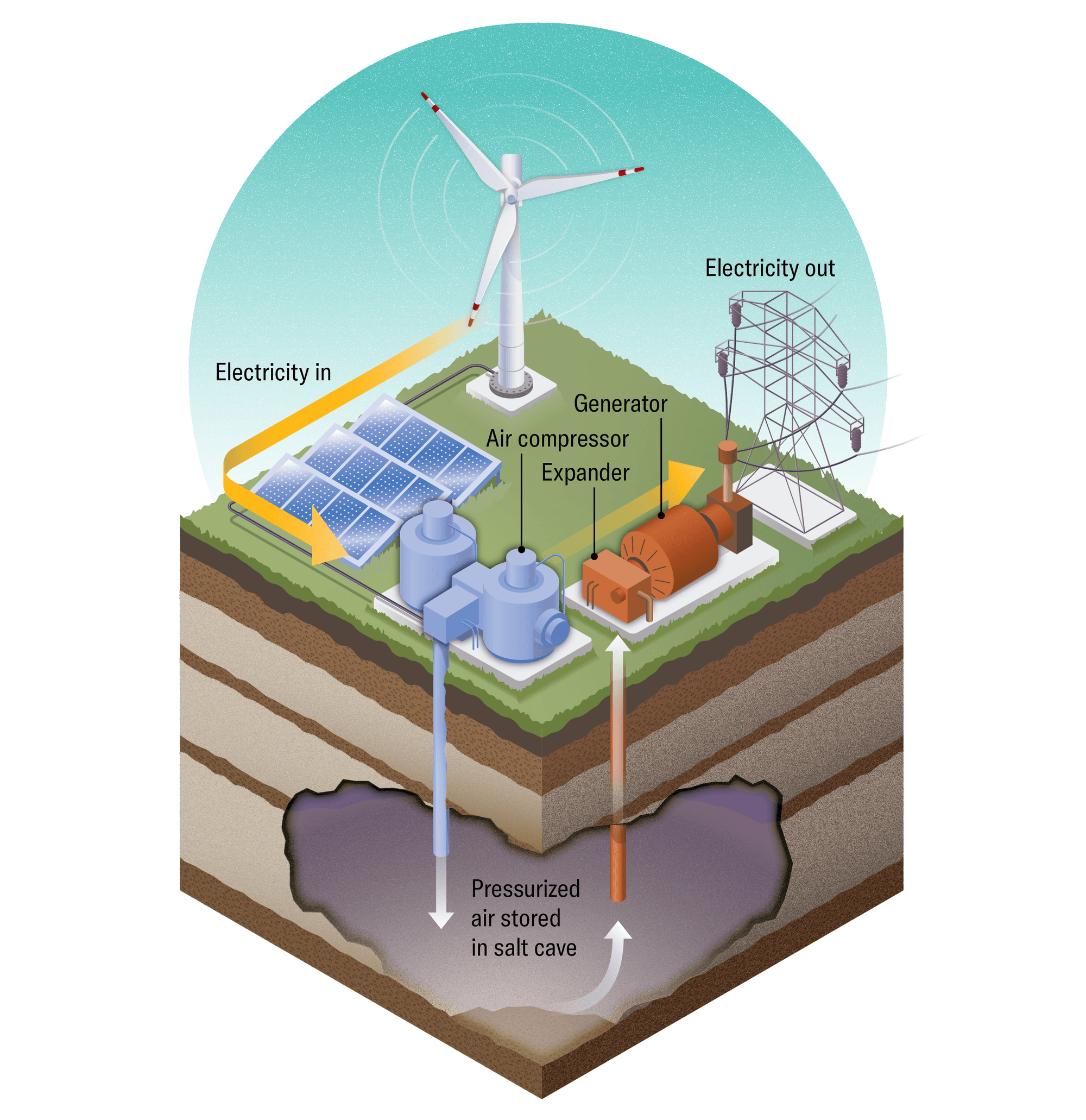
How it works: When demand for electricity is low, surplus energy generated by solar and wind farms can be used to power compressors that squeeze air to high pressures and pump it into underground caverns. Then, when demand rises, the pressurized air can be released to generate power. This technology, known as compressed air energy storage (CAES), dates to the late 1970s but “never really made it into the mainstream,” says Paul Denholm, a senior research fellow at the National Laboratory of the Rockies.
In recent years, though, China has commissioned several CAES plants, including the world’s largest: the Huai’an Salt Cavern project, expected to power some 600,000 homes. Salt caverns are especially well suited to this purpose: rock salt is more or less impermeable and deforms to self-seal any fractures that may form, preventing the stored air from leaking out.
There is a potential problem with this type of energy storage: compressed air cools as it reexpands, meaning it has to be warmed before it can spin a turbine efficiently. This project hopes to solve that issue by storing thermal energy in molten salt and water to reheat the air.
Why it’s needed: The success of renewables depends on the ability to store energy for times when the sun isn’t shining and the wind isn’t blowing. The energy-storage market is currently dominated by lithium-ion batteries, but Denholm says they’re economically viable only for storage durations of a few hours. He argues that CAES, though expensive up front, is easier to scale and can store and supply energy for a day or longer, depending on the size of the cavern. “Air is free,” Denholm says, “and a hole in the ground can potentially be cheap.”
What the experts say: Although the technology is mature, according to Pirouz Kavehpour, a mechanical engineer at the University of California, Los Angeles, geology limits its potential. Outside of China there are only two major CAES plants in the world—in Germany and in Alabama—and both rely on salt caverns. But a recently permitted project in California would use hard-rock caverns, which could expand possibilities for the technology. “It’s been 30 years since we built one of these things in this country,” Denholm says, but he remains cautiously optimistic. —Cody Cottier
Nick Bockelman
Deep-Sea Offshore Wind
The world’s largest single floating wind turbine can withstand supertyphoons
Name of project: Sanxia Linghang Hao (Three Gorges Pilot) platform
Location: China
Name of technology: Floating offshore wind turbine
Power generation: 16 megawatts
How it works: China’s Sanxia Linghang Hao offshore wind turbine, installed in May, is the largest single floating turbine in the world. It floats some 70 kilometers offshore in more than 50 meters of water atop a partly submerged platform, rather than a piling embedded in the seafloor as most offshore turbines are, which would be too expensive in such deep waters. In its mooring system, polyester cables and anchor chains act as springs that help to absorb the force of waves and wind. The turbine’s blades, with a tip height of 270 meters, are built to withstand winds up to 264 kilometers per hour, according to Three Gorges Corporation, faster than those produced by the strongest typhoons. (The company did not reply to interview requests.)
Why it’s needed: Offshore winds are stronger and steadier than near-shore winds, so turbines far from coasts can deliver more power with better reliability than near-shore turbines. Perhaps 80 percent of potential offshore wind energy is in deep waters that require floating, anchored turbines. Far offshore, they also avoid the community complaints about visibility that plague near-shore wind farms. With the U.S. halting leases and permits for offshore wind facilities, the action on the technology has moved to Asia and Europe: Italy alone has about 90 far-offshore wind facilities under environmental review.
What the experts say: These offshore floating wind facilities are technologically mature and have “crystal clear” low-cost energy potential, says marine scientist Roberto Danovaro of Italy’s Marche Polytechnic University. The only real issue is their ecological impact, he says. “If adequately assessed, located and mitigated, their ecological and environmental impact can be negligible, and their benefits can be huge,” Danovaro says. —Dan Vergano

Nick Bockelman